Do these four things first
If your apartment loses air conditioning during a summer power outage, take these four immediate steps to protect your household and stay as cool as possible:
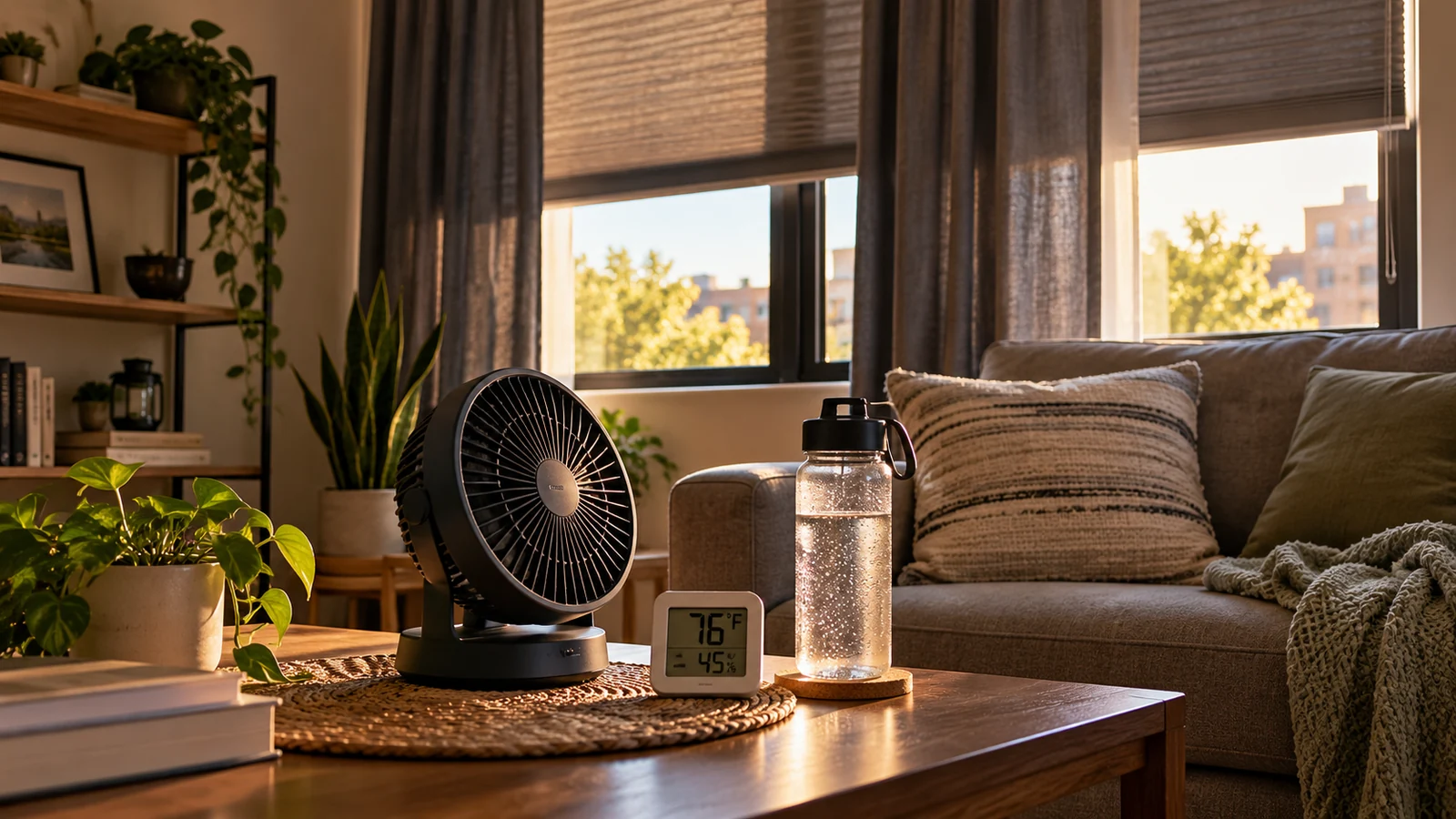
- Block Direct Sunlight Before It Heats Your Living Space: Draw blinds, shades, or curtains on sun-facing windows early in the morning before direct solar radiation hits the glass. Stopping solar heat at the window is far more effective than trying to cool air after heat has penetrated interior rooms.
- Eliminate Unnecessary Indoor Heat Sources: Turn off unused electronics, LED lights, and appliances. Avoid using gas or electric cooktops, ovens, or dishwashers, as appliance waste heat accumulates rapidly in enclosed apartments.
- Cool Your Body Directly: Take cool or tepid showers, apply damp cloths to high-blood-flow pulse points (neck, wrists, armpits), wear lightweight, loose-fitting clothing, and sip plain water regularly throughout the day before feeling thirsty.
- Monitor Indoor Conditions and Confirm an Exit Plan: Use a room thermometer to track indoor air temperature and monitor all household members for signs of heat strain. If indoor heat rises—especially for older adults, infants, or residents with health conditions—or if local public health limits are reached, prepare to relocate to a confirmed, actively cooled space or shaded outdoor area.
IMPORTANT PUBLIC HEALTH NOTE ON FANS: Portable electric fans move air across skin to speed sweat evaporation, but they do not cool room air. Public health guidance varies by jurisdiction: Toronto Public Health specifically advises against using electric fans when indoor temperatures reach 34°C (93.2°F) or higher (especially in closed rooms with no outdoor air exchange), while Health Canada and the BC Centre for Disease Control warn that fans become ineffective at lowering body temperature above 35°C (95°F). Pushing very hot air across skin can accelerate dehydration and heat strain rather than relieve it. Fans should never replace access to an actively cooled space.
1. What Changes in an Apartment During a Summer Power Outage?
When a power grid failure coincides with a summer heat wave, an apartment building loses more than just primary mechanical air conditioning. Multi-family residential buildings rely on shared electrical infrastructure that can experience compounding utility disruptions during a blackout:
- Loss of Primary Mechanical Air Conditioning: Window units, split systems, and central chiller loops stop immediately. Without mechanical refrigeration, indoor air in unshaded or upper-level apartments begins to absorb heat from surrounding structure walls and solar glass exposure.
- Disruption of Central Exhaust Ventilation: Many modern multi-unit buildings use continuously powered central exhaust fans located on rooflines or utility shafts to draw stale air from windowless bathrooms and kitchens. When these fans stop, moisture from cooking or bathing stays trapped inside, increasing indoor humidity and reducing the body’s ability to evaporate sweat effectively.
- Potential Water Pressure Drops on Upper Floors: High-rise residential buildings rely on electric booster pumps to supply water to upper stories. During a widespread blackout, if building or municipal backup power is absent or depleted, water pressure on higher floors may drop or fail entirely, limiting access to tap water for cool showers or damp towels.
- Elevator Inoperability and Enclosed Stairwells: Elevators stop functioning unless supported by building emergency generators. Enclosed interior stairwells without natural windows or mechanical ventilation can become extremely hot and dark. For older adults, residents with mobility limitations, or families with young children, navigating multiple flights of hot stairs requires substantial physical exertion that can trigger heat exhaustion.
- Battery Power Depletion: Rechargeable personal fans, emergency lights, and smartphones draw from finite battery reserves. Managing backup power requires balancing communication, lighting, and direct personal airflow.
(For detailed guidance on how multi-unit building utilities operate during power disruptions, see our guide on Apartment Building Services During a Power Outage).
2. Choose a Cooling Strategy Based on Your Apartment Layout
How quickly an apartment heats up depends on its orientation, vertical position, and window layout. Adjusting your tactics to your unit’s specific design helps minimize heat buildup:
| Apartment Layout & Orientation | Thermal Behavior in a Blackout | Practical Renter Action |
|---|---|---|
| South- or West-Facing Windows | Receives intense direct sunlight from midday through late afternoon, creating significant solar heat gain. | Draw interior blackout drapes or shades early in the morning before sun hits the glass. If considering exterior shading or window films, verify lease and building management rules first. |
| Top-Floor or Upper-Level Units | Heat rises within the building, and top-floor ceilings absorb thermal radiation from hot roof surfaces. | Shift resting areas to lower or interior shaded rooms during peak daytime hours; use battery fans for personal airflow; prepare to relocate if indoor heat climbs. |
| Single-Aspect Layout (Windows on One Side Only) | Lacks natural cross-ventilation, causing warm air to remain trapped without mechanical air movement. | Place a battery fan near an open window during cool nighttime hours to pull outside air into the apartment or push warm air out. |
| Dual-Aspect Layout (Windows on Opposite Sides) | Can take advantage of natural wind pressure differentials across opposite exterior walls. | Open windows on opposite sides of the apartment during cool nighttime hours to establish natural cross-ventilation. |
The Critical Ventilation Rule: Daytime Closing vs. Nighttime Flushing
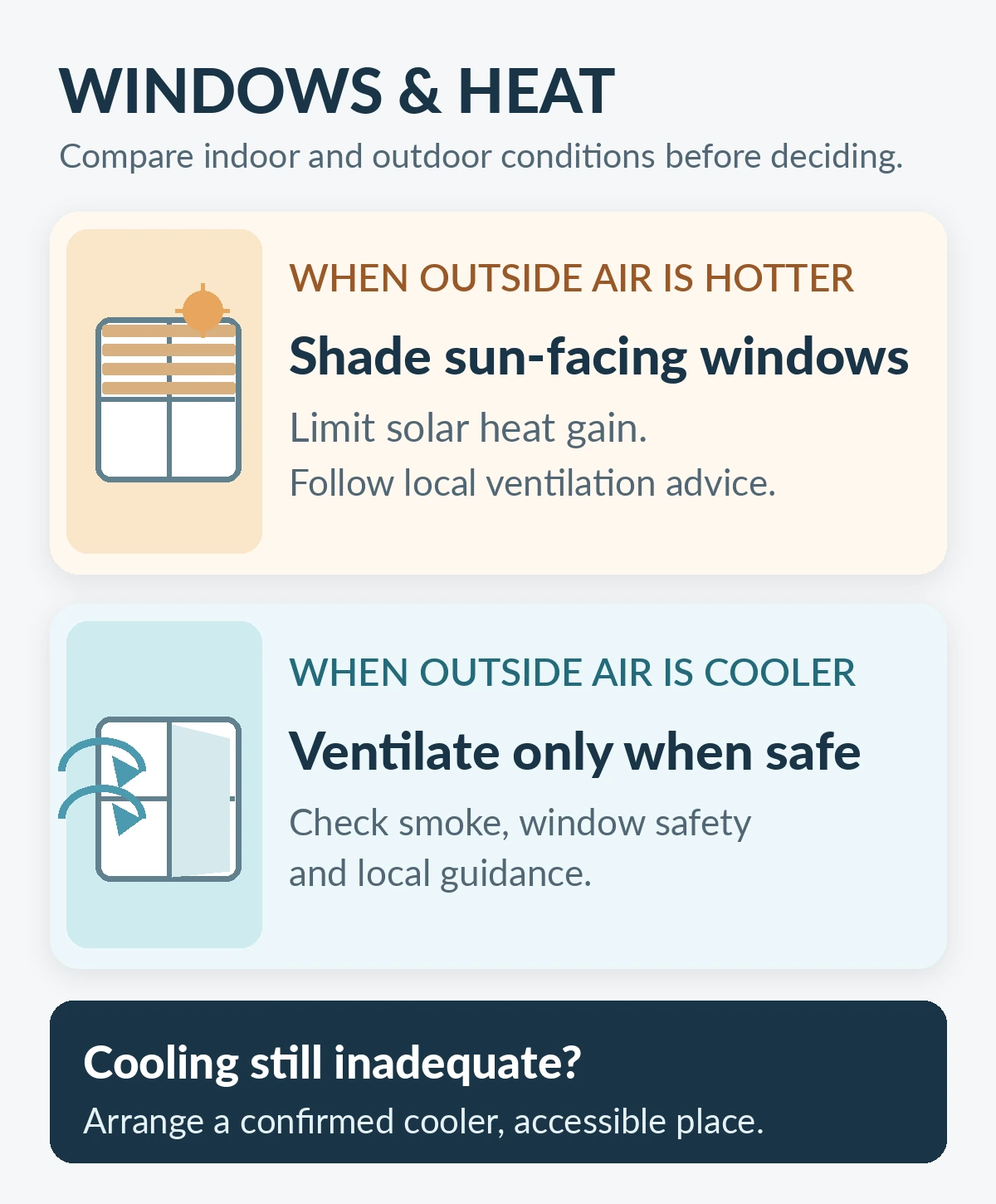
A common mistake during a summer power outage is leaving windows open all day in hopes of catching a breeze. If outdoor air is warmer than indoor air, opening windows pulls superheated air inside, accelerating apartment heat gain.
- Daytime Protocol (Sun Up): Keep exterior windows, doors, and blinds closed whenever the outdoor air temperature exceeds the indoor air temperature, unless local safety advice or indoor ventilation needs require a different action.
- Nighttime Protocol (Sun Down): Monitor outdoor temperatures. Once outdoor air drops below indoor room temperature, open windows on shaded or leeward sides of the building to flush out warm trapped air.
- Wildfire Smoke & Air Quality Nuance: The BC Centre for Disease Control (BCCDC) notes that during extreme heat events accompanied by wildfire smoke advisories, keeping cool takes priority over short-term air quality concerns for most people. However, people with severe asthma, COPD or other respiratory illness may need a cool, filtered indoor destination and individualized advice.
- Fan and ventilation caution: Toronto Public Health advises against using a fan in a closed room without an exterior-open window or door. That does not mean you should open a window into hotter or smoky air solely to run a fan. When safe ventilation is unavailable, use water-based personal cooling and arrange a confirmed cooled space; do not treat a battery fan in a sealed hot room as an adequate heat-safety plan.
3. Battery-Powered Fans: Capabilities, Limits, and High-Heat Hazards
Small battery-powered fans are among the most practical personal comfort tools during a blackout, but understanding their physical operation and public health boundaries is essential for safety.
What Fans Can and Cannot Do
- Fans Cool People, Not Rooms: Electric fans move air across exposed skin, increasing convective heat transfer and accelerating perspiration evaporation. Fans do not contain refrigeration loops; they do not remove heat energy from a room. Running a fan in an empty, sealed room actually adds a small amount of motor waste heat to the space.
- Public Health Guidelines & Jurisdictional Fan Limits:
- Toronto Public Health: Advises not to use fans when indoor room temperatures reach 34°C (93.2°F) or higher. It also cautions against using a fan in a closed room without outdoor ventilation. Both precautions matter independently; do not infer that opening a window makes fan use safe at 34°C.
- Health Canada & BCCDC: Caution that electric fans become ineffective at lowering core body temperature when room air approaches or exceeds 35°C (95°F).
- International Context (WHO): The World Health Organization (WHO) uses a different threshold of 40°C. These are agency-specific guidelines, not one universal physiological cutoff. Follow your local public-health advice; in Toronto, do not use fans when a room reaches 34°C.
- Individual Health Vulnerabilities: Older adults (age 60+), young children, and individuals taking certain prescription medications (such as anticholinergics, diuretics, or psychiatric medications) have reduced sweating capacity or altered thirst perception. For these residents, relying solely on fan airflow during high heat is unsafe; direct water cooling or relocation to an air-conditioned environment is required.
4. Small-Battery Fan Runtime & Sizing Worksheet
Quick takeaway: The examples below estimate battery-fan runtimes using stated assumptions. For a 256 Wh battery, the example 10 W USB fan runs about 21.2 hours, while the 30 W AC fan with inverter losses runs about 5.45 hours. These fans have different power draws, so this is not an equal-airflow comparison. Actual runtimes vary with equipment and battery condition, and fan runtime does not establish heat safety.
Planning continuous airflow during an extended blackout requires calculating fan power draw against usable battery capacity while accounting for electrical conversion efficiency and idle energy consumption.
Understanding Electrical Efficiency: Direct DC vs. AC Inverter Paths
The electrical path between your battery and the fan motor determines how long your energy reserve will last:
- Direct DC Path (USB or Integrated DC Personal Fans): Power flows directly from an internal lithium battery or external USB power bank to a DC brushless motor. DC-to-DC conversion efficiency is high (~90%–92%) with zero inverter idle consumption.
- AC Inverter Path (120V Standard Table Fans on Portable Power Stations): A portable power station’s internal inverter converts DC battery power into 120V AC household electricity. This conversion introduces efficiency losses (~15%) plus a continuous inverter idle consumption (typically 5W to 10W continuously whenever the AC outlets are turned on, regardless of fan speed).
Show the calculation (optional)
Mathematical Energy Accounting Model
Usable Battery Energy (Wh) = Nominal Capacity (Wh) × Usable Fraction (DoD) × State of Health (SoH)
AC Total Battery Draw (W) = (Fan Load W / Inverter Efficiency) + Inverter Idle Draw W
DC Total Battery Draw (W) = Fan Load W / DC Efficiency
Estimated Continuous Runtime = Usable Battery Energy (Wh) / Total Battery Draw (W)
Illustrative Worked Fan Sizing Scenarios
To illustrate energy accounting principles, consider three common hypothetical blackout setups (calculated using standard nominal specifications):
| Setup Parameter | Scenario A: 30W 120V AC Fan on 256Wh Power Station | Scenario B: 10W USB DC Fan on 256Wh Power Station | Scenario C: Integrated USB Rechargeable Fan (148Wh Internal Pack) |
|---|---|---|---|
| Battery Type & Nominal Capacity | External LiFePO4 (256 Wh nominal) | External LiFePO4 (256 Wh nominal) | Integrated Li-ion (148 Wh nominal / 40,000 mAh at 3.7V) |
| Usable Battery Capacity | 230.4 Wh (90% usable DoD) | 230.4 Wh (90% usable DoD) | 125.8 Wh (85% usable DoD / BMS cutoff) |
| Electrical Conversion Path | 120V AC Inverter Path | Direct USB DC Port | Internal Direct DC Motor Circuit |
| Conversion Efficiency & Idle Draw | 85% Inverter Efficiency + 7W Inverter Idle | 92% DC-DC Port Efficiency (0W Inverter Idle) | Integrated Direct DC (0W Inverter Idle) |
| Fan Motor Power Draw | 30.0 W (Continuous AC) | 10.0 W (Continuous DC) | 1.1 W (Low Speed) / 12.0 W (Max Speed) |
| Calculated Total Battery Draw | (30W / 0.85) + 7W = 42.29 W | 10W / 0.92 = 10.87 W | 1.1 W (Low) / 12.0 W (Max) |
| Estimated Continuous Runtime | ~5.45 Hours | ~21.2 Hours | ~114 Hours (Low) / ~10.5 Hours (Max) |
Note: The scenarios above are illustrative calculations based on specified rating assumptions. Actual runtimes vary by manufacturer design, motor efficiency, ambient temperature, and battery condition.
Battery Ageing & Planning Margins
Battery capacity degrades over time through repeated charge cycles. Accounting for battery health ensures your planning remains realistic over multiple years of ownership:
- Accounting for Battery Ageing (80% State of Health): An aged 148 Wh nominal integrated fan battery operating at 80% State of Health (SoH) and an 85% Depth of Discharge (DoD) cutoff provides an aged usable capacity of:
Under these aged conditions, estimated runtime is ~91.5 hours on Low (1.1W) and ~8.4 hours on Max (12W). - Planning Margins for Overnight AC Fan Operation: To power a 30W AC fan overnight (8 hours continuous) through a 120V inverter drawing 42.29W total from the battery, the required battery energy over 8 hours is:
The minimum fresh nominal battery capacity required (at 90% DoD) is:
- Fresh Battery Margin (500Wh Station): A fresh 500Wh class power station provides 450 Wh usable energy (at 90% DoD). Running an 8-hour 30W AC fan load consumes 338.3 Wh out of 450 Wh usable, leaving a comfortable 111.7 Wh spare buffer (~24.8% unused planning margin).
- Aged Battery Margin (500Wh Station at 80% SoH): As the power station ages to 80% State of Health (SoH) over repeated charge cycles, its usable capacity decreases to:
Under aged conditions, an 8-hour 30W AC fan run consumes 338.3 Wh out of 360 Wh usable, leaving only 21.7 Wh spare (~6.0% margin). - Planning Takeaway: Readers who want to maintain a persistent ~20%–25% safety buffer over the multi-year life of an aged battery station should select a larger capacity station (~600Wh+) or utilize high-efficiency direct USB DC fans.
Step-by-Step Fan Runtime Worksheet
Use this 4-step logic to estimate runtimes for your backup equipment:
- Find Nominal Battery Energy ( in Wh): Look for the Watt-hour rating on your battery label. If listed in mAh:
- Calculate Usable Energy ( in Wh): Multiply nominal Wh by 0.85 (for standard Li-ion) or 0.90 (for LiFePO4 power stations):
- Determine Total Battery Draw ( in Watts):
- For Direct USB DC Fans:
- For 120V AC Fans on Inverters:
- For Direct USB DC Fans:
- Calculate Continuous Hours: Divide by :
(For comprehensive guidance on sizing portable power stations for multi-device apartment outage needs, see our guide on Portable Power Station Sizing & Energy Accounting).
5. Safe Personal Cooling Without Grid Power
When electricity is unavailable to cool ambient room air, focus your efforts on supporting physiological body temperature regulation through water application, hydration, and behavioral adaptation:
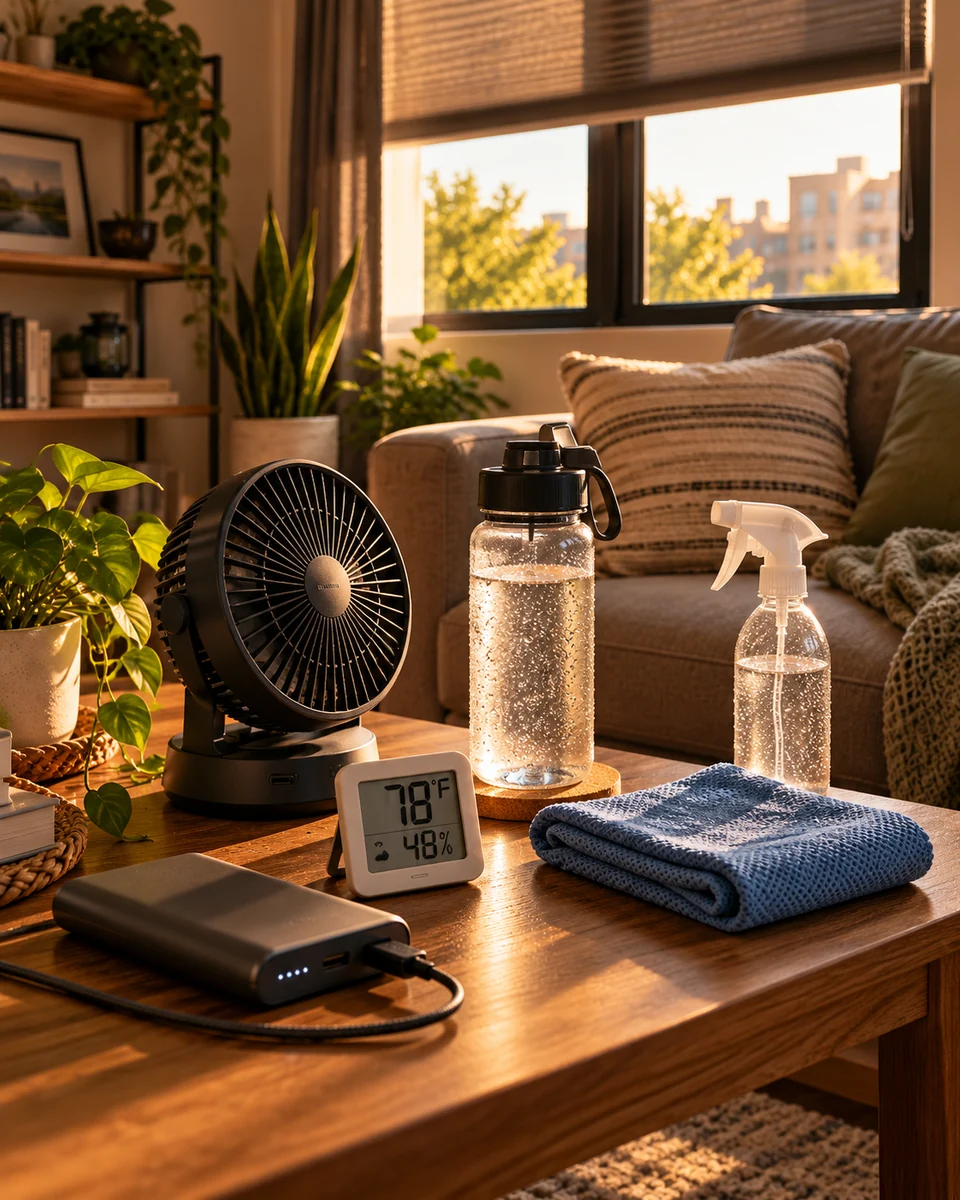
1. Water-Based Personal Cooling
Water transfers heat away from the skin significantly faster than air. Applying tap water directly to the body is the most effective non-electrical personal cooling technique:
- Cool Showers and Tepid Baths: Sitting in a cool or tepid bath transfers body heat directly into the water. Avoid icy-cold water for routine cooling, as extreme cold can cause blood vessels near the skin to constrict, reducing heat loss from core tissues.
- Pulse-Point Damping: Apply cool, damp cloths or towels to areas where major blood vessels pass near the skin: the back of the neck, inner wrists, armpits, and groin.
- Evaporative Misting: Use a manual spray bottle to apply a fine water mist over exposed arms and legs while sitting near a personal battery fan to maximize evaporative cooling.
- Emergency Rapid Cooling for Suspected Heat Stroke: If anyone shows signs of Heat Stroke (confusion, altered mental state, slurred speech, high body temperature, unconsciousness), call 911 / local emergency services immediately. While waiting for emergency responders, initiate rapid external cooling using whatever safe water source is available—apply cold wet sheets, cool water, or ice packs to the neck, armpits, and groin, per CDC Heat Stress emergency guidance and Health Canada protocols. Do not attempt to give fluids to an unconscious or confused person.
2. Hydration Protocols
Dehydration reduces perspiration capacity, significantly increasing core heat strain:
- Sip Plain Water Regularly: Drink water consistently throughout the day rather than waiting for strong thirst cues.
- Monitor Urine Color: Clear or pale straw-colored urine indicates proper hydration; dark yellow or amber urine signals dehydration requiring increased fluid intake.
- Beverage Nuance: Avoid alcohol, which promotes fluid loss. According to Health Canada’s technical heat guidelines for health professionals, habitual coffee or tea drinkers do not need complete caffeine abstinence, but should avoid increasing caffeine intake or relying on sugary energy drinks during extreme heat.
- Medical Fluid Restrictions: Residents with heart failure, kidney disease, or physician-prescribed fluid restrictions must consult their healthcare provider or pharmacist regarding fluid intake management during heat events.
3. Spot-Cooling with Ice Bowls
Placing a bowl or bucket of ice directly in front of a personal fan creates a small zone of localized spot-cooling in the immediate airflow path. While this can provide pleasant direct comfort for an individual sitting nearby, it does not condition an entire apartment room. Use this technique for direct personal spot-cooling while resting nearby, rather than expecting whole-room temperature reduction.
6. When Staying in the Apartment Is No Longer Safe & Planning Relocation
A vital part of summer outage planning is recognizing when indoor temperatures exceed safe physiological limits and executing a preplanned relocation to a cooler space.
Understanding Public Health Indoor Temperature Guidelines
Public health agencies publish indoor temperature thresholds to help residents gauge environmental heat risk:
- 26°C (78.8°F) Protective Level for Older Adults: Health Canada’s guidance on upper indoor temperature limits for older adults identifies 26°C as a protective action threshold for adults aged 60 and older, noting that sustained temperatures above 26°C increase cardiovascular strain and that frail individuals may require support even below this level.
- 31°C (87.8°F) High-Risk Threshold: The BC Centre for Disease Control (BCCDC) and Toronto Public Health advise that sustained indoor exposure at or above 31°C poses significant health risks. Public health guidance recommends that heat-vulnerable individuals spend at least 3 hours per day in an air-conditioned environment when indoor heat reaches this level.
- Very-hot-room fan precautions (vary by authority): Toronto Public Health says do not use fans when the room is at 34°C or higher. Health Canada cautions that fans are ineffective at cooling the body above 35°C. These are agency-specific guidelines, not one universal cutoff. If cooling is inadequate, seek a confirmed cooler and accessible place or assistance; a fan alone is not a heat-illness prevention plan.
Practical Heat Risk & Action Matrix
The decision to remain in an apartment versus relocating depends on indoor temperature, resident health vulnerability, exposure duration, and mobility:
| Indoor Room Temp Range | Resident Vulnerability Profile | Applicable Guidance Source | Recommended Action & Escalation Steps |
|---|---|---|---|
| Below 26°C (78.8°F) | General planning baseline; individual risks still vary | Health Canada / BCCDC | Maintain heat precautions: Keep sun-facing shades drawn, monitor people and symptoms, and bring in cooler night air when safe. A thermometer reading alone cannot guarantee safety for every individual. |
| 26°C to 30.9°C (78.8°F–87.6°F) | Older Adults (60+), Infants, Chronic Conditions | Health Canada / BCCDC | Initiate Active Personal Cooling: Use battery fans directed at skin, apply damp cloths to pulse points, take cool showers, and check in with a buddy twice daily. |
| 31°C to 33.9°C (87.8°F–93.0°F) | Heat-Susceptible Residents / All Populations | BCCDC / Toronto Public Health | Seek Cooled Accommodation: Heat-susceptible residents should spend at least 3 hours per day in a confirmed air-conditioned space. Monitor all occupants for heat strain. |
| 34°C or higher (93.2°F+) — Toronto’s local fan limit | Anyone in a very hot room, especially heat-vulnerable residents | Toronto Public Health (34°C); Health Canada (fans ineffective above 35°C) | Do not use a fan at Toronto’s stated room-temperature cutoff. Use water-based cooling and arrange a confirmed cooler, accessible destination or emergency assistance as appropriate. Seek help earlier if symptoms, vulnerable health status, or prolonged heat exposure warrant it. |
| Any Temperature | Anyone displaying confusion, hot dry/damp skin, or unconsciousness | Health Canada / CDC Emergency Protocols | MEDICAL EMERGENCY — CALL 911 IMMEDIATELY: Initiate rapid external cooling with cold water/ice packs while waiting for emergency responders. Do not give fluids if altered. |
Recognizing Heat Illness Warning Signs
| Symptom Category | Heat Exhaustion (Warning Stage) | Heat Stroke (LIFE-THREATENING EMERGENCY) |
|---|---|---|
| Primary Symptoms | Heavy sweating, dizziness, headache, nausea or vomiting, muscle cramps, weakness, intense thirst. | Confusion, altered mental state, slurred speech, high body temperature, hot red skin (dry or damp), loss of consciousness, seizures. |
| Required Action | Move immediately to a cooler space, loosen clothing, apply damp towels, sip cool water, rest. | CALL 911 IMMEDIATELY. Move person to shade/cool area, initiate rapid external cooling with cold water/ice packs. Do not offer drinks. |
Planning Outage Relocation During Regional Blackouts
Do not wait until heat illness symptoms appear to plan an exit:
- Verify Functioning Destinations: During a widespread grid outage, local shopping centers, libraries, or community cooling centers may also lose power unless equipped with standby generators. Always call ahead or check municipal emergency updates to confirm a destination is open and actively cooled before traveling.
- Plan Accessible Non-Elevator Routes: Identify exit paths that do not require working elevators. Ensure stairwell access is clear and lighted by emergency battery fixtures. If stairwell evacuation is impossible due to severe mobility limitations or disability, contact building management, local emergency services, or your designated buddy network immediately for assisted relocation support.
- Establish a Daily Buddy System: Arrange a twice-daily check-in protocol with a family member, neighbor, or friend—especially for residents who live alone, have mobility limitations, or lack personal transportation.
(For immediate priority planning during the initial hours of a grid failure, see our First 24 Hours Power Outage Emergency Plan).
7. Renter-Friendly Apartment Summer Outage Kit
Preparing an apartment for a summer power outage requires zero permanent alterations, making these preparation tools suitable for rental units and condominiums:
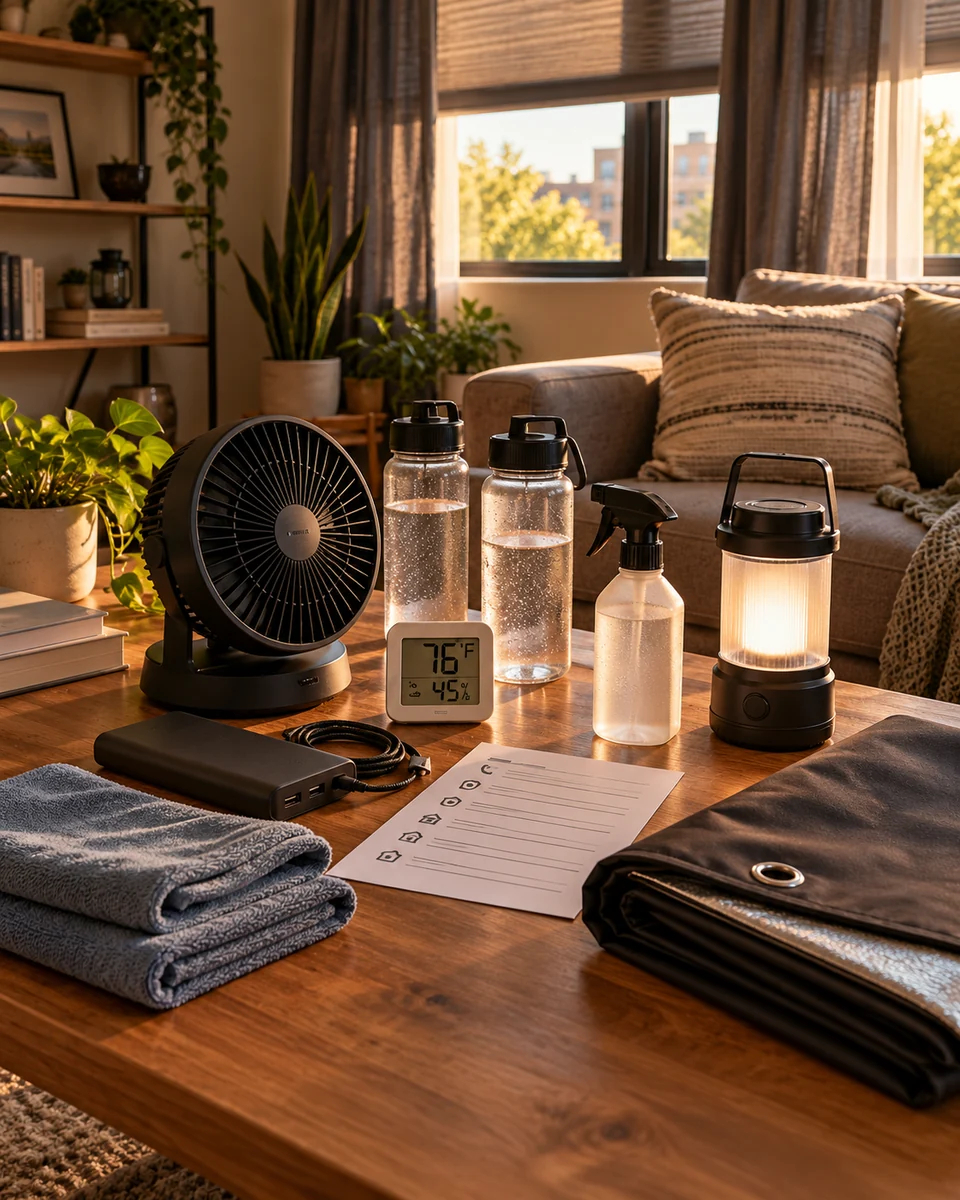
- Digital Room Thermometer: A clear, battery-operated thermometer placed at head level in your main living space to track indoor temperatures accurately against public health guidance.
- Removable Solar Window Shading: Blackout curtains, tension-rod insulated drapes, or temporary window shades. (Check lease agreements and building bylaws before installing exterior shades or tinting window glass).
- Rechargeable USB Personal Fan: A multi-speed DC fan equipped with a high-capacity integrated battery or USB power cable capable of delivering multi-hour personal airflow on low or medium settings.
- Dedicated USB Power Bank: A 10,000 mAh to 20,000 mAh USB power bank reserved strictly for topping off personal fans and maintaining mobile phone communication. (See our guide on How to Charge Phones During a Power Outage).
- Stored Emergency Water: A minimum of 3 to 4 liters of clean drinking water per person per day stored in a cool, shaded area.
- Spray Misting Bottle & Microfiber Towels: A manual pump spray bottle paired with lightweight microfiber cooling towels for pulse-point damping.
- Printed Emergency & Relocation Directory: A paper contact list containing local emergency numbers, verified municipal cooling center locations, and neighbor check-in contact details.
8. Frequently Asked Questions (FAQ)
Does running an electric fan lower the actual room temperature?
No. Electric fans move air across human skin to accelerate sweat evaporation and convective heat loss, which cools the person, not the room. In an empty, enclosed room, a fan’s electric motor actually releases a minor amount of waste heat into the space.
Does placing a bowl of ice in front of a fan help cool an apartment?
It provides temporary, localized spot-cooling directly in front of the fan, but will not cool an entire room. Air passing over ice creates a small zone of cooler airflow directly in the fan’s path. Use this technique for direct personal spot-cooling while resting nearby, rather than expecting whole-room temperature reduction.
Should I open my apartment windows during a daytime summer blackout?
Keep windows closed when outside air is hotter than inside, unless ventilation requirements or local safety advice require otherwise. Open windows when the outside air is cooler AND doing so is safe; sunset alone does not establish safety. Account for smoke, respiratory needs, window/child safety and local guidance. Do not open into hotter or smoky air solely to use a fan; if safe ventilation is unavailable, use alternative personal cooling and seek a confirmed cooler accessible place or assistance.
Can a portable power station run a portable air conditioner during a power outage?
Only if the power station can handle the air conditioner’s measured steady power and startup demand. Air conditioners often have much larger energy needs than personal fans, but actual wattage, motor startup and power-station limits are model-specific. For illustration only, if an AC unit draws a constant 800–1,200 W and a 500 Wh station delivers 90% usable energy with 85% inverter efficiency and 7 W idle draw, the calculated duration is roughly 19–29 minutes—provided the appliance starts and runs without exceeding the inverter’s rating. These are assumptions, not tested runtimes. Use product-specific watt measurements, rated surge capability, and a practical reserve when sizing any backup.
How long will a battery-powered fan run during a power outage?
Runtime depends on fan motor power draw, battery capacity, and electrical conversion path. Direct USB DC personal fans draw less power and avoid AC inverter losses, delivering substantially longer runtime per Watt-hour of battery capacity than standard 120V AC fans run through power station inverters.
(Compare summer heat management strategies with our winter grid-resilience guide: How to Keep an Apartment Warm During a Winter Power Outage).