When the power goes out, how long can your fridge and freezer keep food safe? Knowing how long food can last in a fridge without power is an urgent concern when the grid fails. The answer depends on outage duration, door discipline, internal loading, and ambient room temperature. Here is what you need to know before deciding what to keep or throw away—based on official public-health guidance from the USDA, CDC, Health Canada, and FoodSafety.gov.
1. Quick Answer: Fridge vs. Freezer Cooling Timelines
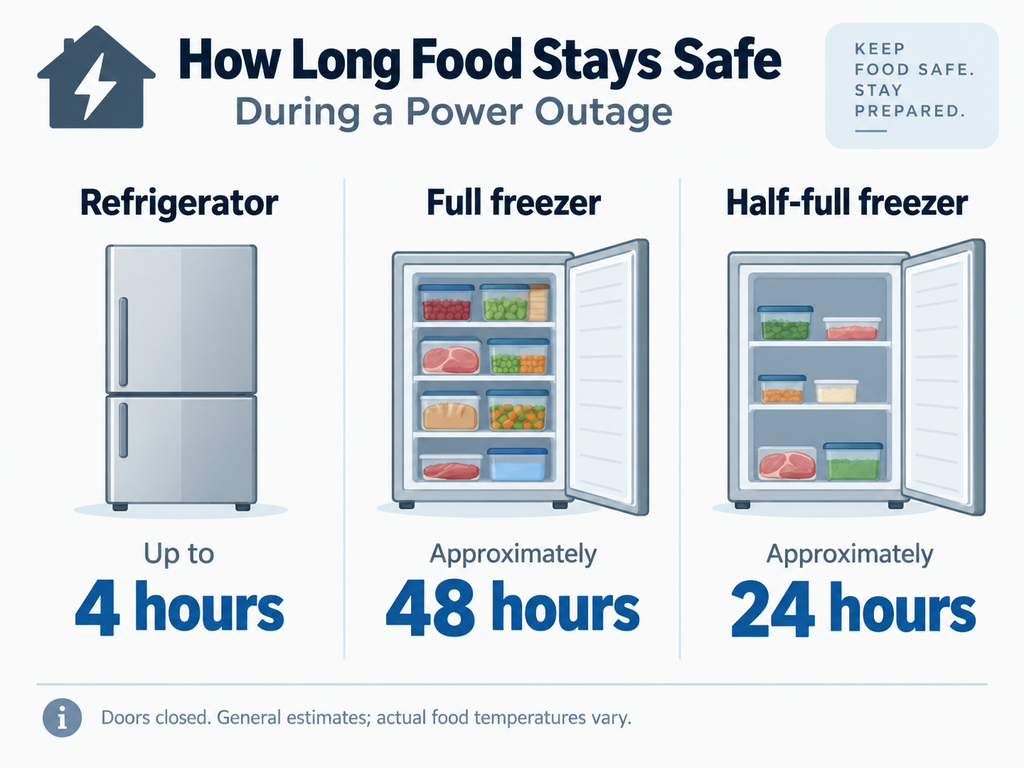
If you keep the appliance doors strictly closed, public health authorities establish the following baseline food safety holding windows:
- Unopened Refrigerator: Keeps perishable food safely cold (at or below 40°F / 4°C) for up to 4 hours.
- Unopened Full Freezer: Food generally remains at a safe temperature for approximately 48 hours if the freezer started properly cold and its door stays closed.
- Unopened Half-Full Freezer: Food generally remains at a safe temperature for approximately 24 hours under the same conditions.
| Appliance State | Recommended Holding Window (Doors Closed) | Key Assessment Boundary |
|---|---|---|
| Refrigerator | Up to 4 hours | Perishable food exposed to temperatures at or above 40°F (4°C) for 2 hours or more must be discarded. |
| Full Freezer | Approximately 48 hours | Food containing visible ice crystals or measuring 40°F (4°C) or below at assessment can generally be safely refrozen or cooked. |
| Half-Full Freezer | Approximately 24 hours | After thawing, consult the food-specific frozen-food chart. Many high-risk perishables must be discarded after unsafe warming, but other frozen foods have different guidance. Check the item’s temperature and history when available. |
The Temperature Danger Zone: Harmful foodborne bacteria (Salmonella, E. coli, Listeria) multiply rapidly between 40°F and 140°F (4°C to 60°C). When an unpowered refrigerator warms up past 40°F, perishable items enter this danger zone, increasing the risk of foodborne illness.
Apartment Refrigerator Note: These baseline holding windows are general emergency estimates for stand-alone appliances. A freezer compartment built inside a standard or compact apartment combination refrigerator-freezer may not stay cold as long as a dedicated chest or upright freezer. Always judge safety based on actual appliance conditions and food-specific assessment rather than elapsed time alone.
Understanding the Two Food-Safety Clocks:
Public health guidance relies on two distinct, non-additive timing rules:
- Clock 1 — Closed-refrigerator planning window (about four hours): CDC and FoodSafety.gov advise that food in a refrigerator with the door kept closed generally remains safe for up to four hours after power loss, assuming safe storage before the outage. This guideline does not establish the exact warming curve or temperature history of a particular appliance or food item. This 4-hour window is an emergency planning guideline, not proof that a specific refrigerator reaches 40°F at exactly four hours.
- Clock 2 — Measured Warm Exposure Boundary (2 Hours Max): Once perishable food is measured or known to be at or above 40°F (4°C), it enters the Temperature Danger Zone. Perishables may not remain in this danger zone for more than 2 hours total.
The four-hour unopened-refrigerator window is a conservative decision point in public-health guidance, not a measurement of when a particular refrigerator reaches 40°F (4°C). Unless continued safe cold storage can be established, follow the official recommendation to discard refrigerated perishables after four hours without power or another effective cold source. Do not assume an additional two-hour grace period.
Hot Weather Handling Note: For perishable food left out unrefrigerated in ambient temperatures above 90°F (32°C), general USDA handling guidance reduces the room-temperature limit to one hour. This is distinct from monitored food held safely cold in a refrigerator or cooler.
2. What to Do Immediately When Power Goes Out
When facing a power outage, taking four immediate steps within the first few minutes can help reduce food loss and keep your household safe:
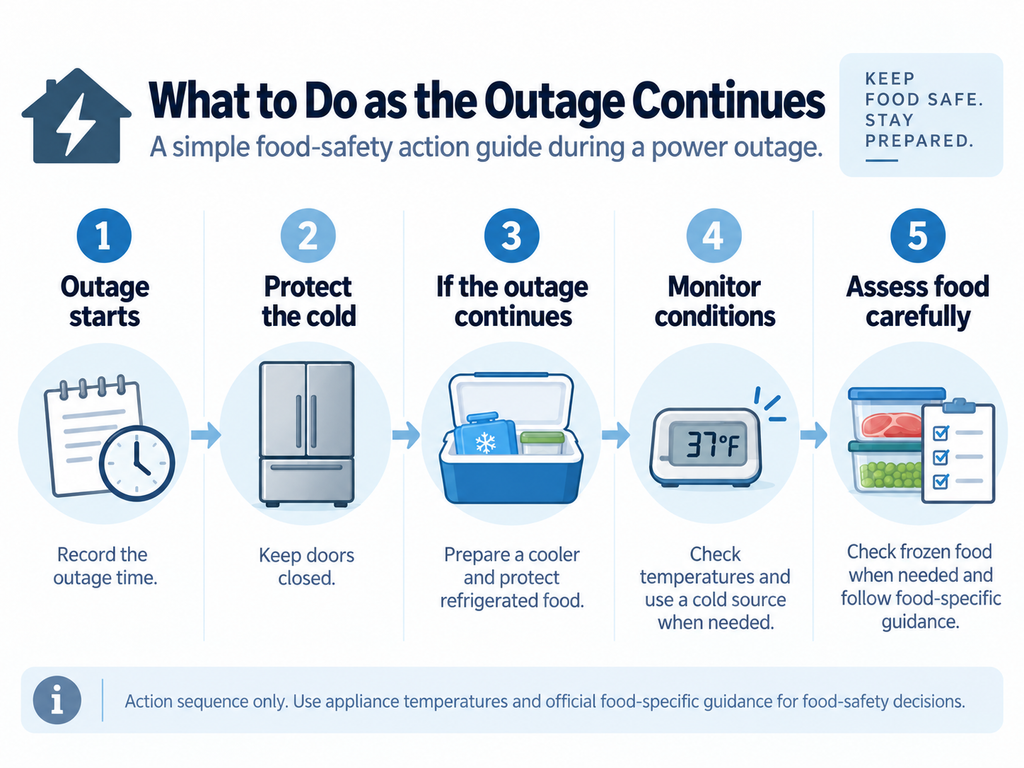
- Note the Outage Start Time: Write down the exact time the power failed or set a phone reminder. Having an accurate timeline prevents dangerous guesswork hours later.
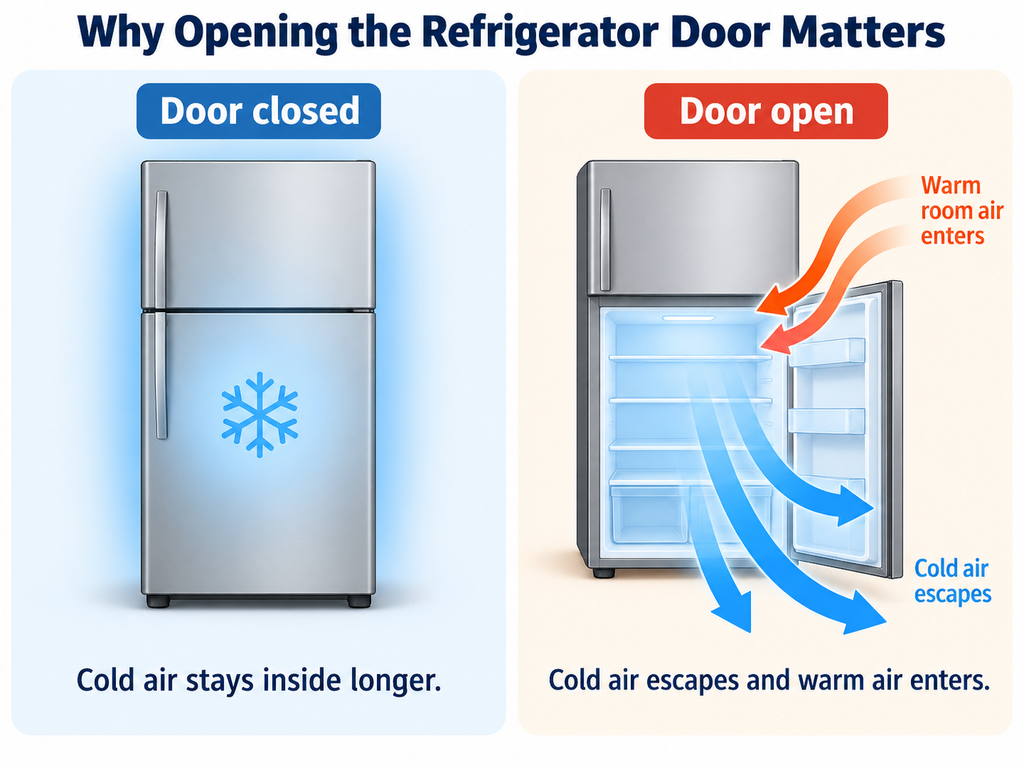
- Keep the Doors Closed: Every time an appliance door opens, chilled air escapes and warm ambient air rushes in. Treat your unpowered refrigerator like an insulated cooler—keep it sealed until you have a clear plan.
- Check Appliance Thermometers: If your fridge or freezer has an external temperature display or wireless sensor, monitor internal temperatures from the outside without opening the door.
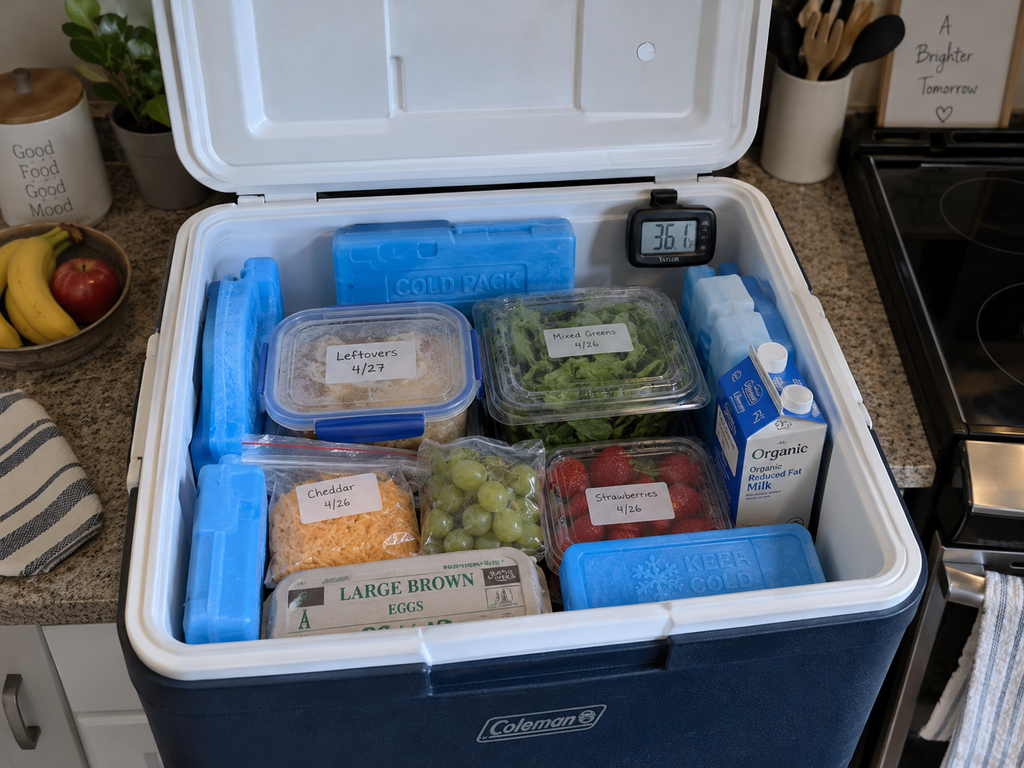
- Prepare a Cooler for Extended Outages: If the power outage is projected to exceed 4 hours, locate a portable cooler along with frozen gel packs or ice. Moving high-priority perishables into a packed cooler before the 4-hour mark extends their safe holding time, provided you maintain temperatures at or below 40°F (4°C).
Practical Triage Decision Path
When evaluating food safety during or after an outage, follow this 3-way assessment path for food that was properly stored prior to power loss:
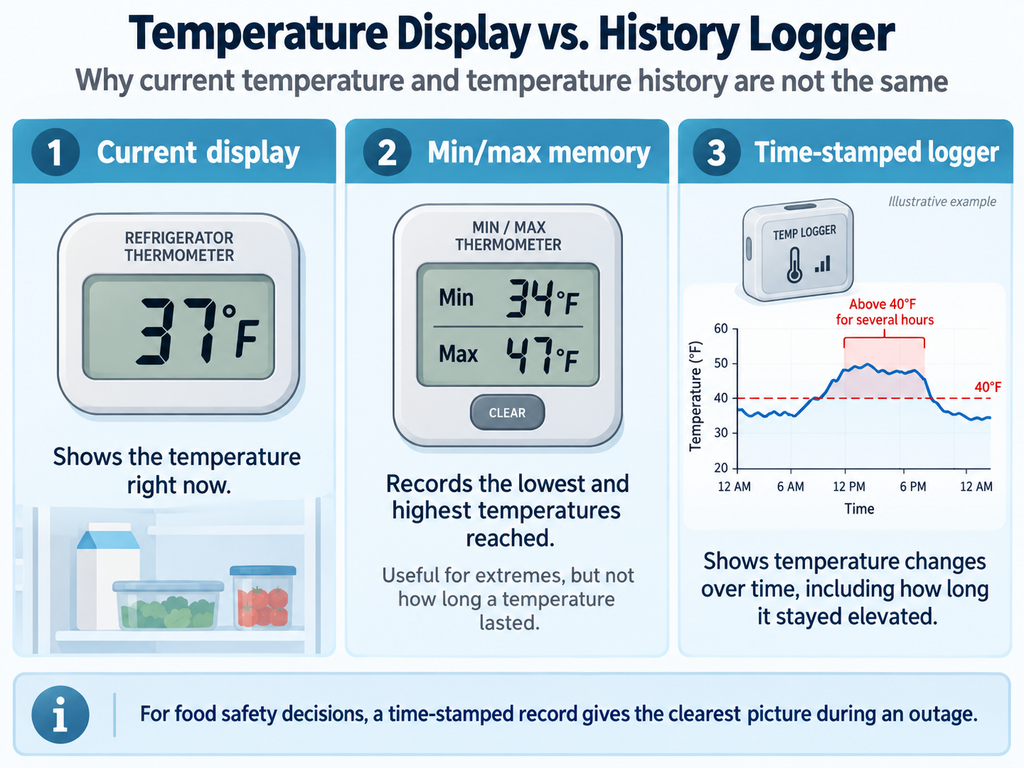
- Path A — Known Safe Temperature History: If a time-stamped digital logger or continuous temperature monitoring confirms internal temperatures remained strictly at or below 40°F (4°C) throughout the outage, refrigerated perishables generally remain safe. (Note: While an air/sensor log provides strong cabinet evidence, sensor air history recorded at a single location does not automatically guarantee every individual food item’s internal temperature, due to natural temperature variations across different areas of the cabinet).
- Path B — Cold Source Available: If perishables were moved promptly into a cooler packed with ice or frozen gel packs, verify that the cold source actually maintains food temperatures at or below 40°F (4°C). Do not rely solely on the visual presence of ice without confirming food temperature.
- Path C — Unknown or Unmonitored History (>4 Hours): If the refrigerator was without power for over 4 hours, lacked an alternate cold source, and lacks a time-stamped temperature log proving continuous chill, follow official public health guidance and discard high-risk perishables. Never use a normal temperature reading taken hours after power returns as proof that food stayed cold during the outage.
3. How Long Food Lasts in a Fridge
A central concern during a blackout is how long a refrigerator can maintain safe storage conditions before internal temperatures rise to unsafe levels. A standard upright refrigerator is designed to keep food chilled between 35°F and 38°F (1.6°C to 3.3°C). Without electricity, how quickly internal temperatures rise depends on door usage, room temperature, and internal loading.
Why Opening the Door Matters
How long a fridge can stay cold without power depends heavily on door discipline, indoor ambient temperature, and thermal mass. Cold air is denser and heavier than warm room air. When you open a standard front-opening refrigerator door, chilled air cascades out from the bottom while warm indoor air is drawn into the top.
Repeatedly opening the door during a blackout strips away internal cold air, accelerating warming and reducing how long food stays safely cold.
Room Temperature and Small-Space Constraints
In compact apartments, condos, or townhouses—especially during summer months—indoor temperatures can rise quickly without air conditioning. Warmer ambient air surrounding a small refrigerator causes internal temperatures to climb faster than in a cool, climate-controlled environment.
Air Circulation vs. Freezer Packing
While freezers benefit from being densely packed with solid frozen items, refrigerators operate differently. Health Canada advises against overpacking a refrigerator because cold air must be able to circulate effectively around items. Fill empty shelf spaces with chilled water bottles to build thermal reserve, but avoid cramming shelves so tightly that airflow is completely blocked.
4. How Long Food Lasts in a Freezer
When evaluating freezer performance during a power failure, solid ice mass gives freezers a major thermal advantage over refrigerators. Freezers maintain safe temperatures far longer than refrigerators because solid ice absorbs a significant amount of heat energy as it melts before its temperature rises above freezing.
Full vs. Half-Full Freezers
A primary factor determining freezer holding time is overall loading density. A fully packed freezer acts as a consolidated block of cold mass. Surrounding frozen goods insulate one another, offering an approximate holding window of up to 48 hours. A half-empty freezer contains more air space, cutting the approximate holding window to 24 hours. The 24- and 48-hour estimates are general guides, not tested runtimes for every freezer. Compact refrigerator-freezer combinations and other models may behave differently depending on their design, starting temperature, loading, door openings and surrounding conditions. Use appliance and food-temperature evidence where available.
Chest Freezers vs. Upright Freezers
If you have a dedicated chest freezer in a basement, utility closet, or storage area, its top-opening design traps heavy cold air inside even when the lid is lifted briefly. Front-opening upright freezers allow cold air to spill out from the bottom when opened. Note that regardless of freezer type, manufacturer clearance and ventilation requirements must still be followed in small spaces.
The Refreezing Rules & Important Exceptions
When evaluating freezer contents during or after a power outage:
- Safe to Refreeze or Cook: Foods that still contain visible ice crystals or measure 40°F (4°C) or below at the time of assessment can generally be safely refrozen or cooked immediately.
- Assessment After Power Restoration: Check freezer contents as soon as practical when power returns. If the freezer has already been running on grid power for several hours before assessment, current temperatures or newly formed ice crystals alone cannot confirm earlier temperature history. Consider the total outage duration and any reliable recorded temperatures.
- Quality Considerations: Refreezing thawed items may alter texture, moisture, or flavor (especially in cooked meats, breads, or delicate produce), but it remains microbially safe if proper temperature thresholds were maintained.
- Important Category Exceptions:
- Ice Cream & Frozen Yogurt: Discard once softened, thawed, or melted—even if visible ice crystals remain—as directed by the official FoodSafety.gov frozen-food chart. Refreezing severely ruins texture, and melted dairy ice cream provides an ideal environment for bacterial growth if warmed.
- Commercial & Homemade Frozen Bread Doughs / Pie Crusts: Frozen bread doughs and pie crusts can be safely refrozen if thawed, though considerable quality or rise loss may occur. (Note: This applies to frozen doughs; ready-to-bake refrigerated doughs in cardboard cans must be discarded if exposed to 40°F (4°C) or above for 2 hours or more).
- Custard- or Cheese-Filled Pies & Pastries: Discard if thawed and exposed to temperatures at or above 40°F (4°C) for 2 hours or more.
- Always check official guidance: Refer to the FoodSafety.gov Frozen Food Chart for item-by-item rules.
5. Power Outage Food Safety: What to Keep and What to Throw Away
When power returns—or after 4 hours without refrigeration—evaluate each item separately. When sorting perishable food items during a power outage, separating high-risk items from shelf-stable goods prevents unnecessary waste.
Adapted from the FoodSafety.gov Refrigerator Food Safety Chart. See official guidance for product-specific exceptions.
| Food Category | DISCARD (Perishable foods exposed to 40°F / 4°C or above for 2 hours or more) | KEEP (Foods that generally do not require disposal solely because of 40°F / 4°C exposure) |
|---|---|---|
| Meat, Poultry & Seafood | • Raw or cooked meat, poultry, fish, seafood • Meat, tuna, chicken, or egg salads • Gravy, stuffing, broth, stews, casseroles • Lunch meats, hot dogs, bacon, sausage • Canned hams labeled “Keep Refrigerated” • Opened canned meats or fish | • Unopened shelf-stable canned meats or fish • Unopened dry-cured meat specifically labeled shelf-stable (follow all refrigeration instructions after opening) |
| Cheese & Dairy | • Milk, cream, sour cream, buttermilk, yogurt, eggnog • Soft cheeses (Brie, Camembert, Mozzarella, Ricotta, Cottage, Cream cheese, Queso fresco) • Shredded or low-fat cheeses • Opened baby formula | • Hard cheeses (Cheddar, Swiss, Parmesan, Provolone, Colby, Romano) • Processed cheese slices • Butter and margarine • Grated Parmesan or Romano in a jar or can |
| Eggs | • Fresh shell eggs, hard-cooked eggs • Quiches, custards, puddings, egg dishes • Refrigerated liquid egg products | — |
| Fruits & Vegetables | • Cut fresh fruits and cut vegetables • Pre-washed, pre-cut packaged salad greens • Cooked vegetables and baked potatoes • Commercial garlic in oil | • Uncut fresh fruits and uncut vegetables • Opened canned fruits • Dried fruits, raisins, nuts, fresh uncut herbs |
| Sauces, Spreads & Condiments | • Opened creamy-based dressings • Opened fish sauce or oyster sauce • Opened spaghetti/pasta sauce | • Peanut butter, jelly, jam, marmalade • Mustard, ketchup, relish, taco sauce, hot sauce • Opened vinegar-based dressings • Worcestershire, soy, barbecue, and hoisin sauces |
| Breads, Grains & Pastries | • Cooked pasta, rice, quinoa, or potatoes • Refrigerator biscuit, roll, or cookie dough • Cream-, custard-, or cheese-filled pastries and quiches • Fresh pasta | • Bread, rolls, bagels, muffins, tortillas • Baked fruit pies • Cakes and cookies (without cream or custard fillings) |
Special condiment rule: For opened mayonnaise, tartar sauce, and horseradish, FoodSafety.gov instructs disposal if held above 50°F (10°C) for more than eight hours.
Note: This is a simplified quick-reference guide based on official public-health standards. Always follow product-specific storage instructions, discard any food showing unusual odor, color, or texture, and consult current public-health charts for specific product guidelines. In ambient room temperatures exceeding 90°F (32°C), the 2-hour exposure limit for DISCARD items sitting unrefrigerated reduces to 1 hour.
6. Scenario Guide: Power Out for 4, 8, 12, 24, or 48+ Hours
Instead of assuming fixed internal temperature changes, use this action-based scenario guide to manage your food safely during an ongoing blackout:
Power Out for 0 to 4 Hours
- Appliance Status: Under normal starting conditions, unopened refrigerators and freezers generally maintain safe temperatures (at or below 40°F / 4°C) during the first four hours.
- Action Required: When the refrigerator was at a safe temperature before the outage and its door remains closed, its contents will generally stay safely cold for up to four hours. If food was already too warm, the door was frequently opened, or another contamination concern exists, follow the relevant food-specific guidance instead. If local utility updates indicate an extended outage, locate your cooler, ice supplies, and food thermometer.
Power Out for 4 to 12 Hours
- Appliance Status: Unopened refrigerators reach the 4-hour point at which refrigerated perishables must be assessed under official safety guidance. Freezers generally remain within their safe holding window.
- Action Required:
- Refrigerator: If a refrigerator has been without power for 8 hours and no backup cooling or cold source maintained safe temperatures (≤40°F / 4°C), discard refrigerated perishable items such as meat, poultry, seafood, milk, eggs, soft cheeses, cooked leftovers, and cut produce in line with official emergency guidance. Do not assume those items stayed below 40°F for exactly 4 hours or calculate a known warm-exposure duration from outage length alone.
- Freezer: Keep freezer doors closed; frozen food will generally remain safe during this period if the freezer began at the proper temperature and stayed closed.
Power Out for 12 to 24 Hours
- Appliance Status: Unopened half-full freezers approach their approximate 24-hour holding limit. Full freezers generally have a longer holding window.
- Action Required:
- When power returns—or when accessing food—check for visible ice crystals and measure food temperature where needed. Food at or below 40°F (4°C) can generally be refrozen or cooked. Discard fully thawed perishables that have sat at or above 40°F (4°C) for 2 hours or more. Until power returns, keep freezer doors closed as much as possible.
Power Out for 24 to 48 Hours
- Appliance Status: Unopened full freezers reach their approximate 48-hour baseline threshold. Note that half-full freezers have already passed their 24-hour planning window and require item-by-item food safety assessment.
- Action Required:
- When power returns or when accessing food, inspect all freezer shelves. Cook or refreeze items that still contain visible ice crystals or remain at or below 40°F (4°C). Discard any thawed meats, poultry, or casseroles that have been at or above 40°F (4°C) for 2 hours or more.
Power Out Beyond 48 Hours
- Appliance Status: Both refrigerators and freezers have passed standard unpowered holding windows.
- Action Required:
- Do not assume food is automatically safe or unsafe solely from elapsed time. Inspect contents for visible ice crystals, check temperature history records where available, and consult official food-specific charts. Discard any perishable food whose safety cannot be established.
Food Safety Rule: Never taste food to determine whether it is safe. Harmful contamination from bacteria like Salmonella, E. coli, or Listeria may not change the food’s appearance or smell, and reheating cannot reliably make improperly stored food safe. When in doubt, throw it out.
7. Protecting Food During Future Outages (And Backup Power Options)
Building household resilience in an apartment or small home does not require expensive or bulky equipment. Low-cost habits and proportionate power choices offer reliable protection.
Low-Cost Preparation Supplies & Habits
- Digital Appliance Thermometers: Installing a digital thermometer with an external display allows you to monitor internal fridge and freezer temperatures without opening the doors.
- Current Display vs. Temperature History Loggers: A basic external display shows current internal temperature. Devices with a min/max temperature memory record the highest and lowest temperatures reached, while time-stamped data loggers record temperature readings over time. Remember that simple min/max readings show temperature extremes but do not reveal how long a temperature remained elevated. Furthermore, sensor air logs record cabinet air temperature at a single location, which does not automatically guarantee every individual food item’s internal temperature history. A time-stamped log provides the clearest evidence, but high-risk perishables should still be evaluated with care.
- Pre-Freeze Water Containers: Fill clean plastic jugs or water bottles (leaving 10% empty space for expansion) and freeze them. They act as passive cold batteries during blackouts and provide emergency drinking water if needed.
- Cooler & Ice Packs: Keep a compact insulated cooler and reusable gel packs ready to store high-value perishables if an outage exceeds 4 hours.
- A Caveat on the “Bag of Ice Cubes” Trick: Placing loose ice cubes in a freezer bag can provide a rough visual clue—if you find a solid frozen block at the bottom, significant thawing and refreezing occurred. However, this trick cannot establish exact temperature history or prove food safety. Use a thermometer with a temperature log for reliable monitoring.
Evaluating Backup Power: Portable Power Stations
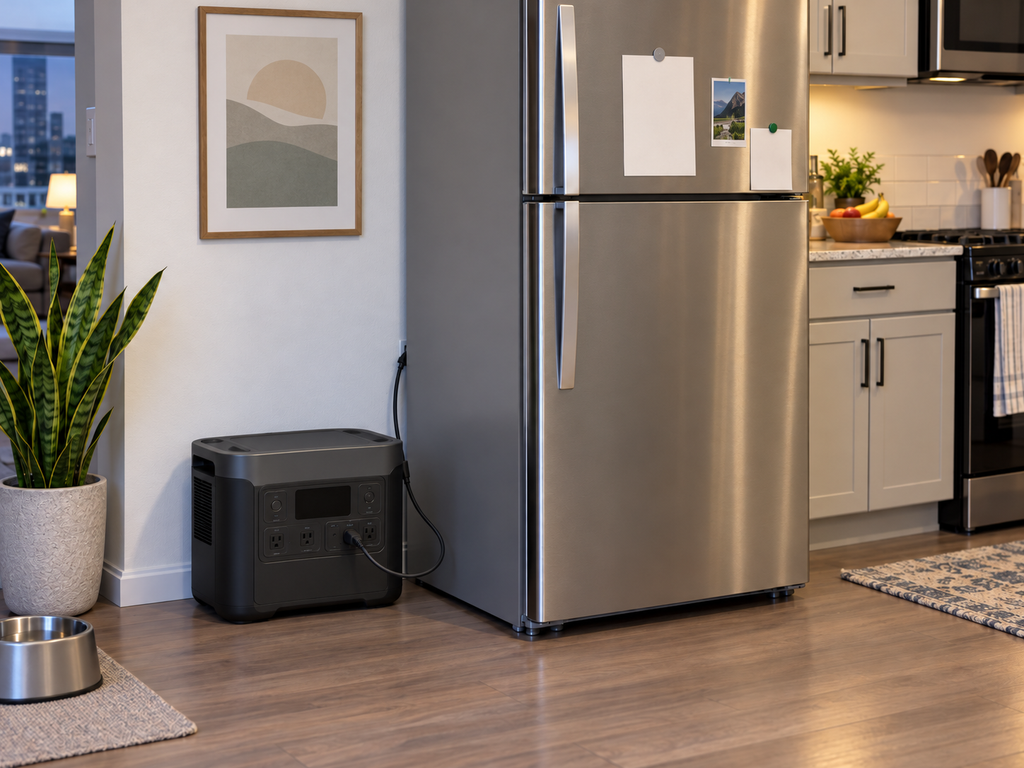
If you experience frequent or multi-day grid disruptions, investing in a refrigerator battery backup (such as a portable power station) can help maintain refrigerator temperatures during an outage, provided it has sufficient usable battery capacity and can handle the compressor’s startup surge.
- Understanding Compressor Power Demand: Refrigerators use electricity intermittently as their compressors cycle on and off. A backup power station must be able to handle both the refrigerator’s continuous running power and its brief startup surge. Actual requirements vary by appliance, so check the manufacturer’s specification label or measure power draw with a watt meter.
- Temperature-Driven Operation: When running a refrigerator on a power station, the battery supplies power while the compressor cycles normally. Monitor internal temperatures and operate the system as needed to keep the appliance interior strictly at or below 40°F (4°C). Actual runtime depends on the refrigerator’s energy draw and the power station’s battery capacity.
- Further Sizing Guidance: For detailed wattage calculations, surge requirements, and battery capacity recommendations, see our dedicated guide: Refrigerator Battery Backup: Is It Worth It for an Apartment?.
8. Frequently Asked Questions (FAQ)
What if I don’t know exactly when the power went out?
If you do not know how long the power was out, check the utility’s outage history and any reliable temperature records. Do not assume refrigerated perishables are safe because they feel cold or the refrigerator currently reads 40°F (4°C) or below—power may have returned and cooled the interior again. If you cannot establish that perishable food remained safely cold, follow official guidance and discard it.
Power returned overnight—how do I know if my food stayed safe?
If power returned while you were asleep, a normal refrigerator temperature in the morning does not prove the food remained safe throughout the night. Once power is restored, the compressor will cool the interior back down. Check your utility’s outage map/history, any time-stamped temperature records, and any available min/max readings. Remember that min/max readings show temperature extremes but do not reveal how long a temperature was reached. If the refrigerator was without power for more than four hours and you cannot verify that perishables stayed at or below 40°F (4°C), discard high-risk items.
The food still feels cold to the touch—is that enough?
Food that feels cold may still have spent too long above a safe refrigeration temperature (40°F / 4°C). Touch is an unreliable guide, and neither a single point-in-time thermometer reading nor a simple min/max record automatically proves every food item’s safety. Use known outage duration, time-stamped temperature records where available, and official food-specific guidance to decide whether food is safe.
Related Guides in Our Home Resilience Series
- Refrigerator Battery Backup: Is It Worth It for an Apartment? (Calculations, surge loads, and battery capacity specs)
- Power Outage Meals for Apartments: What to Eat Without Electricity (Building a shelf-stable emergency pantry)