
If you live in an apartment, condo, or rented home, a sudden power outage can threaten refrigerated food if the interruption lasts long enough. Apartment residents often cannot safely use conventional fuel-burning generators, which must operate outdoors and well away from buildings. Portable battery systems offer an indoor backup-power option, although shorter outages may not require powered refrigeration at all. But with quality portable power stations typically priced from $400 to well over $1,200 USD, a practical question comes first: Is a dedicated refrigerator battery backup actually worth the investment for a small home?
A refrigerator battery backup can be worthwhile if your building experiences frequent or extended power outages, if you regularly keep expensive or large amounts of perishable food, or if you want a battery system that can also support selected household essentials like laptops, Wi-Fi routers, and lighting. But it isn’t necessary for everyone.
During shorter blackouts, an unopened refrigerator can keep food cold for approximately four hours without electricity. Deciding whether to buy a battery comes down to how often outages occur in your area, how much refrigeration you need to protect, and whether the cost is justified for your household.
Is Refrigerator Battery Backup Worth the Cost?
Before spending hundreds of dollars on fridge backup power, it helps to evaluate your actual risk level and consider low-cost or no-cost alternatives. Apartment residents often ask what size generator to run a fridge during an outage; because fuel-burning combustion generators are unsafe for indoor use, calculating equivalent battery capacity in watt-hours provides the safe indoor alternative.
For occasional short blackouts lasting under four hours, you can often solve the problem without buying any equipment simply by keeping the refrigerator door strictly closed. For occasional longer outages, an insulated cooler packed with sufficient ice or frozen gel packs can protect selected perishables, provided food temperatures stay at or below 4°C (40°F). Keep in mind that ice blocks sitting in the freezer will not cool food in a separate cooler until you physically transfer them.
Decision Matrix: Should You Buy a Battery Backup?
| Situation | Recommendation | Primary Reason |
|---|---|---|
| Occasional outages under 4 hours | Usually unnecessary | Closed refrigerator doors maintain safe temperatures for ~4 hours. |
| Infrequent longer outages, modest food inventory | Consider low-cost alternatives | A cooler with enough ice or gel packs can protect selected items if kept at ≤4°C (40°F). |
| Repeated blackouts lasting 6 to 24+ hours | Worth serious consideration | Battery power can reduce recurring food losses and blackout disruption. |
| High value of food or bulk meal preps | Potentially worth it | Protecting $200+ in perishables per outage helps offset battery equipment cost. |
| Battery will also power Wi-Fi, lights, & electronics | Strongest overall value | Multi-device utility justifies the price far better than fridge backup alone. |
| Temperature-sensitive medications | Evaluate specific requirements | Consult healthcare providers and product guidelines for exact storage needs. |
The Financial Break-Even Calculation
To evaluate the financial value, consider a hypothetical comparison (all illustrative costs in USD):
For example, a hypothetical $700 battery that prevents $175 in food losses per extended outage would take approximately four such outages to recover its purchase price through food savings alone (a $600 unit saving $200 per event takes three outages, while an $800 unit saving $150 takes six). That assumes the battery lasts long enough to protect the food and excludes battery wear, alternative cooling costs, and non-financial benefits like peace of mind.
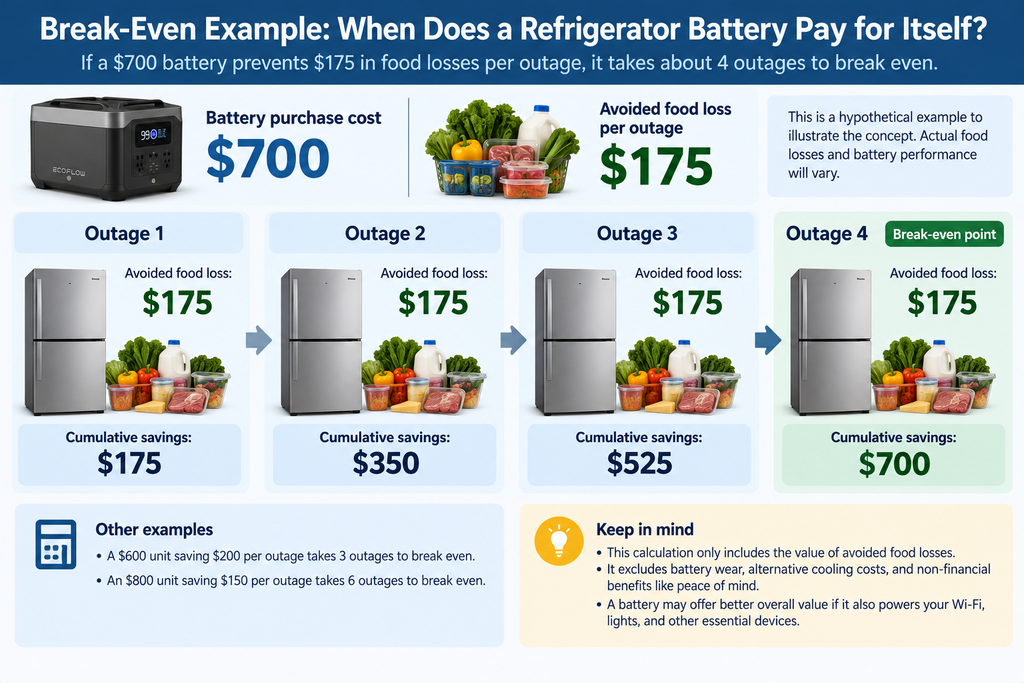
This calculation illustrates an essential rule: preventing food spoilage alone may not financially justify a large battery if you rarely experience long power outages. Buying a battery makes the most sense when outages are frequent or when the battery also serves as a multi-purpose backup for selected household essentials.
How Long Can a Refrigerator Stay Cold Without Power?
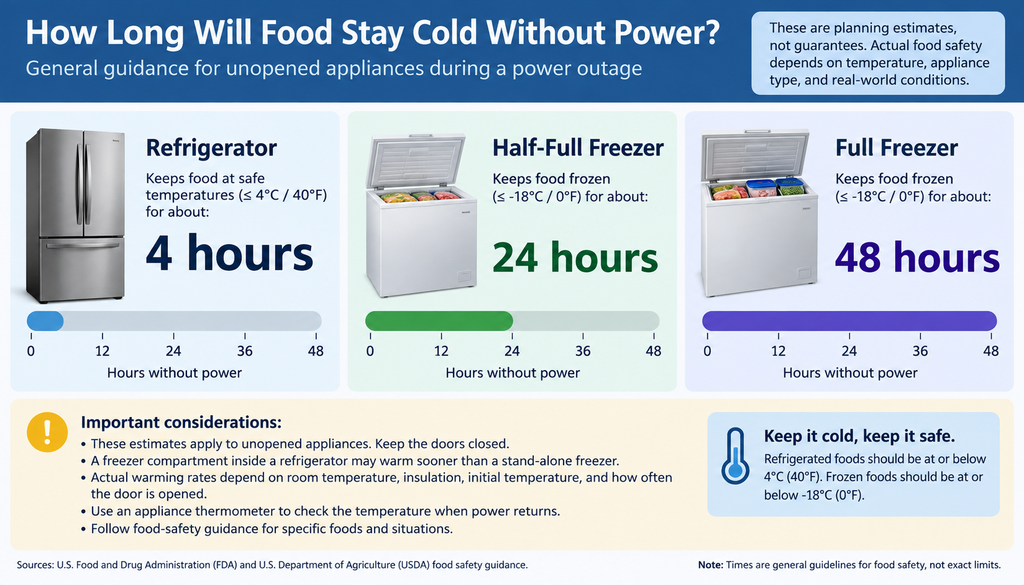
According to public health guidance from the U.S. Food and Drug Administration (FDA) and the U.S. Department of Agriculture (USDA), an unopened household refrigerator will keep food at safe temperatures (below 40°F / 4°C) for about 4 hours during a power outage. A full freezer will hold its temperature for approximately 48 hours (or 24 hours if it is half full). Note that a freezer compartment within a refrigerator-freezer combination may warm sooner than a dedicated stand-alone freezer; monitor actual temperatures and follow food-specific safety guidance rather than relying on maximum time estimates alone.
However, this four-hour guidance is a general planning reference rather than a guaranteed thermal countdown. Real-world warming rates depend on ambient room temperature, refrigerator insulation, initial cabinet temperature, and whether doors remain strictly closed.
Practical Steps During an Outage
- Keep Doors Strictly Closed: Avoid opening the refrigerator door. Every time the door opens, cold air escapes and accelerates temperature rise.
- Use an Appliance Thermometer: Keep an appliance thermometer in the refrigerator and check it promptly when power returns. A single reading cannot establish how long food may have been too warm; follow food-safety guidance using the outage duration, temperature information, and the type of food. A thermometer that records maximum temperature or temperature history can provide additional information.
- Understand Post-Battery Runtime: When backup power stops, the refrigerator begins warming again. If it was holding a normal safe temperature and remains closed, the general four-hour outage guidance may be a useful planning reference, but food safety depends on actual temperatures and conditions—not on a guaranteed four-hour countdown.
Managing cold food without a backup battery is just one part of handling an unexpected blackout. For a complete step-by-step timeline covering lighting, water pressure, electronic building doors, and safety checks, see our complete guide on The Apartment Power Outage Checklist: Your First 24 Hours.
For detailed decision charts on evaluating specific foods, spoilage timelines, and safety thresholds after an outage, see our dedicated guide on apartment food safety during power outages.
How Much Battery Power Does Your Refrigerator Need?
If you decide to invest in battery backup, determining how many watts to run a refrigerator and sizing the equipment accurately requires understanding how appliances draw electricity. When evaluating the wattage of refrigerator models, manufacturers often highlight peak surge ratings or raw capacity numbers that can confuse buyers. To calculate your actual needs, you must separate three distinct electrical concepts:
- Compressor Running Watts (W): The power drawn while the cooling compressor operates. This varies by appliance model, internal capacity, and compressor design (for example, modern variable-speed inverter compressors often run at lower continuous wattage than single-speed motors).
- Startup Surge Watts (W): Some electric motor compressors briefly draw substantially higher power when starting up. Check your refrigerator’s rating plate or manual and confirm the power station can handle its specific surge requirements; a generic surge multiplier is not a compatibility guarantee.
- Average Power (W) and Daily Energy Use (Wh/day): Because a refrigerator compressor cycles on and off (or modulates speed) throughout the day, total daily energy consumption equals average watts multiplied by 24 hours. A fridge drawing an average of 50 W consumes 50 × 24 = 1,200 Wh/day.
How to Find Your Fridge’s Real Power Draw
The EnergyGuide / EnerGuide Label Shortcut
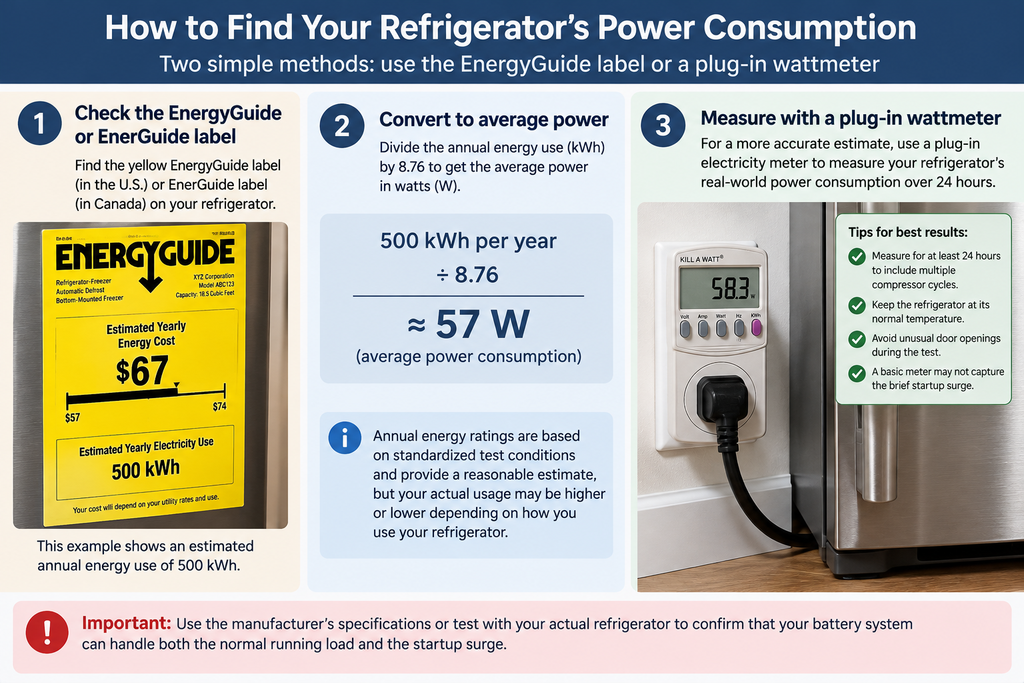
If you do not own a wattmeter to measure your refrigerator power consumption directly, you can estimate your time-averaged power draw using the yellow EnergyGuide label in the United States (overseen by the Federal Trade Commission, using U.S. Department of Energy test procedures) or the EnerGuide label in Canada (administered by Natural Resources Canada). The label reports estimated annual energy consumption in kilowatt-hours (kWh/year).
To convert annual kWh into an average hourly watt draw, convert annual kWh to watt-hours (× 1,000) and divide by the 8,760 hours in a year (which simplifies to dividing annual kWh by 8.76):
$$\text{Average Refrigerator Draw (W)} = \frac{\text{Annual kWh Rating}}{8.76}$$
- Modern Efficient Fridge: A newer full-size refrigerator rated at 500 kWh/year yields:
$$500 \div 8.76 \approx 57\text{ Watts average draw}$$ - Older or Larger Fridge: An older full-size unit rated at 900 kWh/year yields:
$$900 \div 8.76 \approx 103\text{ Watts average draw}$$
Measuring with a Plug-In Wattmeter
For a better estimate based on your own appliance, measure your refrigerator’s energy consumption on wall power for at least 24 hours using a suitably rated plug-in meter (such as a Kill-A-Watt). The meter records cumulative kWh consumed over a full day, capturing your household’s actual compressor cycling and door openings. Note that basic plug-in energy meters record cumulative consumption over time but may not capture rapid transient startup surge spikes.
Illustrative Energy Profiles (Not Appliance-Type Norms)
| Illustrative Energy Profile | Average AC Power | Daily Energy Consumption | Compatibility & Testing Notes |
|---|---|---|---|
| Lower-Consumption Example | 25 W | 600 Wh/day | Hypothetical low-consumption example; not tied to a specific fridge category. Instantaneous running power and startup surge must still be verified. |
| Moderate-Consumption Example | 60 W | 1,440 Wh/day | Moderate-consumption example (approximately 526 kWh/year label rating if sustained as a yearly average). Inverter compressors may run longer at lower draw. |
| Higher-Consumption Example | 120 W | 2,880 Wh/day | Higher-load example; verify your own appliance. Warm ambient temperatures and frequent door openings increase daily energy draw. |
Note: Instantaneous running wattage, startup surge spikes, defrost cycle heaters, and compressor design vary widely by appliance model. For studio apartments or compact spaces, mini fridge watt usage is typically much lower than full-size models, but startup surge compatibility still applies. Always check your refrigerator’s rating plate and test compatibility rather than assuming generic category norms.
How Long Will a 1 kWh or 2 kWh Battery Run Your Fridge?
Calculating real-world runtime when using a portable power station for refrigerator backup requires accounting for two primary energy losses: inverter conversion efficiency and inverter idle overhead.
For the worked examples below, assume 85% AC-conversion efficiency and an illustrative 10 W to 15 W AC-equivalent idle allowance; real efficiency and standby draw vary by product and load. When a power station’s AC outlets are active, its internal electronics consume power continuously just staying powered—even while the refrigerator compressor is resting between cooling cycles.
Planning Runtime Formula
Treat these figures as planning estimates, not minimum guaranteed runtimes. For a simple planning estimate, treat the idle allowance as an equivalent additional AC load. Allow a margin for uncertainty, as real inverter efficiency and standby draw vary by product and load:
$$\text{Estimated Runtime (Hours)} \approx \frac{\text{Battery Rated Capacity (Wh)} \times 0.85}{\text{Average Refrigerator Draw (W)} + \text{Inverter Idle Allowance (W)}}$$
Worked Planning Examples
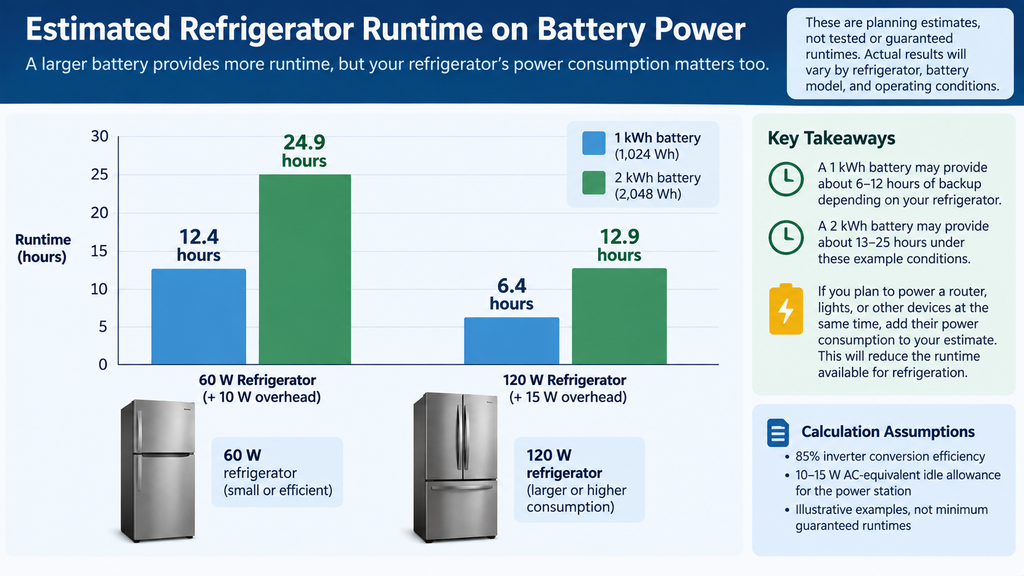
Using an efficient modern refrigerator (60 W average draw) and an illustrative 10 W idle allowance (total 70 W effective load):
- 1,024 Wh Battery (1 kWh Tier):
$$\text{Runtime} \approx \frac{1,024\text{ Wh} \times 0.85}{60\text{ W} + 10\text{ W}} = \frac{870.4}{70} \approx 12.4\text{ Hours}$$ - 2,048 Wh Battery (2 kWh Tier):
$$\text{Runtime} \approx \frac{2,048\text{ Wh} \times 0.85}{60\text{ W} + 10\text{ W}} = \frac{1,740.8}{70} \approx 24.9\text{ Hours}$$
For an older or busier refrigerator (120 W average draw) with a 15 W idle allowance (total 135 W effective load):
- 1,024 Wh Battery: $\approx 6.4\text{ Hours}$ (provides several hours of backup).
- 2,048 Wh Battery: $\approx 12.9\text{ Hours}$ (covers roughly half a day).
Impact of Powering Additional Household Devices
If you plan to power a Wi-Fi router, lighting, or other devices at the same time, add their average wattage to the refrigerator load before estimating runtime. Every additional device consumes energy that would otherwise extend refrigeration. For example, on a 1,024 Wh battery supporting a 60 W fridge (plus 10 W idle allowance), adding a 20 W router increases total draw to 90 W, reducing estimated runtime from 12.4 hours to roughly 9.7 hours ($1,024 \times 0.85 \div 90\text{ W} \approx 9.7\text{ hours}$).
Testing Procedure
To verify your setup, measure your refrigerator’s energy consumption on household power for at least 24 hours using a suitably rated meter. Separately test the power station’s startup compatibility, automatic transfer (if relevant), sustained AC output, and operation across several compressor cycles. A controlled runtime test can improve your estimate without needing to drain the battery completely.
Critical Setting Warning: Check AC Auto-Shutdown
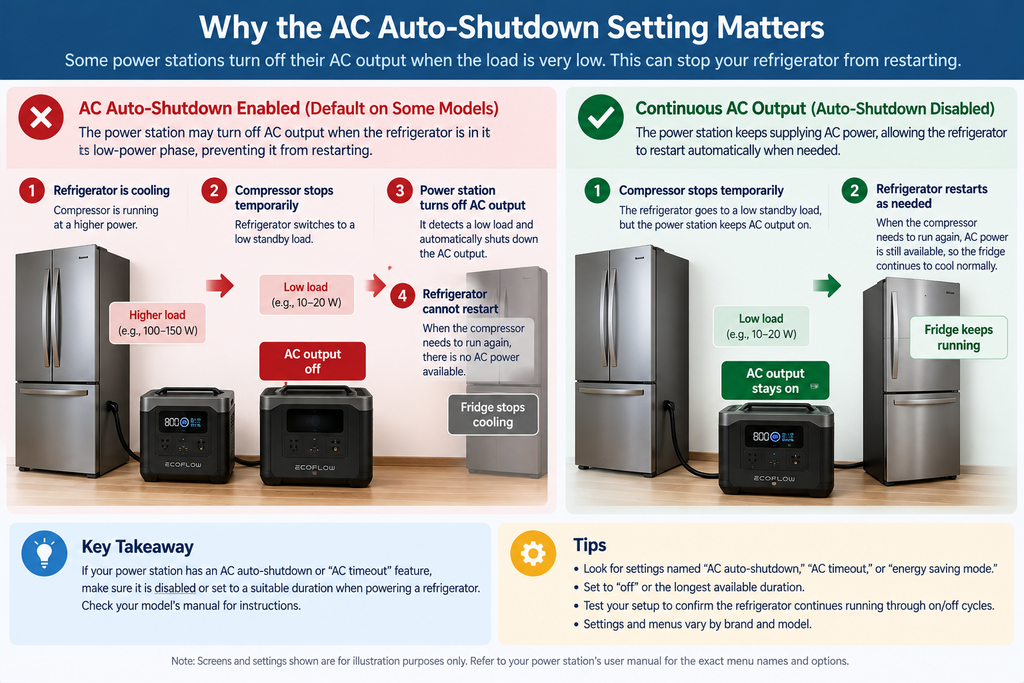
Because a refrigerator draws very little power between compressor cooling cycles, some portable power stations configured with automatic power-saving modes may turn off their AC outlets after detecting a low load during idle periods.
If this occurs during an outage, the AC output may shut off while the compressor is resting, leaving the refrigerator without power when it needs to cool again. Check your specific model’s app or control menu (such as ECO mode settings detailed in manufacturer documentation like the EcoFlow DELTA 2 manual) to ensure automatic AC shutdown is disabled and AC output remains continuously active.
Refrigerator-Oriented Automatic Backup vs. Multi-Use Portable Power Station
Apartment dwellers choosing battery equipment generally select between two distinct product categories:
| Feature | Refrigerator-Oriented Automatic Backup | Multi-Use Portable Power Station |
|---|---|---|
| Form Factor | Often slim, wall-mountable or sits near/atop fridge | Typically boxy cabinet style with carrying handles |
| Primary Role | Dedicated automatic backup for a refrigerator | Multi-purpose backup for selected essentials |
| Switchover Behavior | Automatic transfer (typically 10–20 ms, model-dependent) | Automatic if equipped with EPS/UPS mode; manual otherwise |
| Portability | Often semi-fixed installation in kitchen alcove | Easily moved around apartment or taken outdoors |
| Typical Output | Model-dependent (typically 800 W – 1,800 W) | Model-dependent (typically 1,000 W – 2,400+ W) |
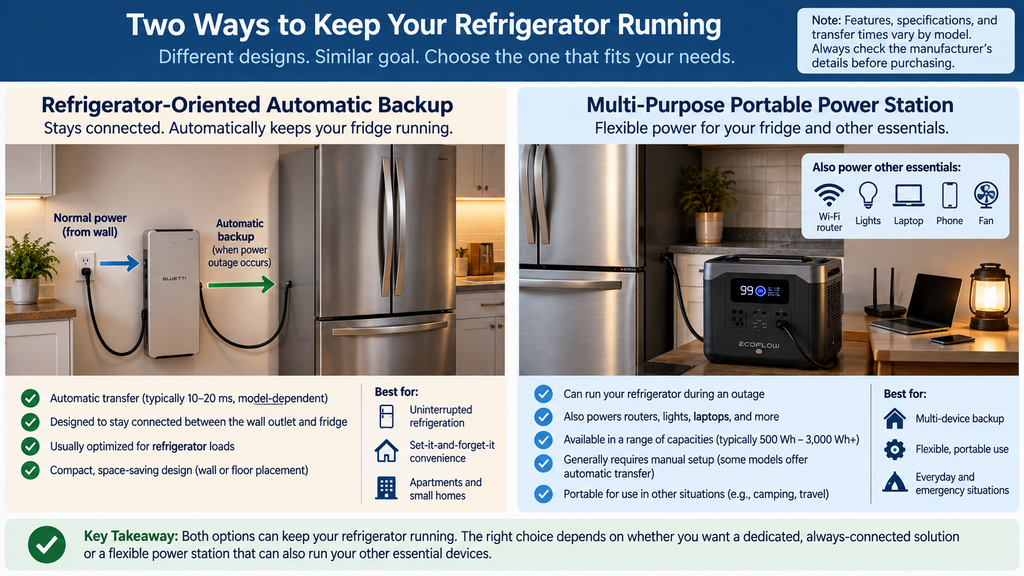
Refrigerator-Oriented Automatic Backup
When selecting an uninterruptible power supply for refrigerator backup, some dedicated systems automatically switch to battery power within about 10–20 milliseconds, while other power stations take longer or lack automatic transfer. Check the actual specification and test compatibility with your refrigerator; automatic switchover does not guarantee that every appliance will operate without interruption. If you want automatic backup while away from home, verify that the model supports manufacturer-approved continuous connection between the wall outlet and refrigerator, automatic transfer during an outage, and the refrigerator’s operating and startup loads.
Multi-Use Portable Power Stations
Standard portable power stations offer traditional cabinets with multiple AC and USB ports. While they take up floor space in small kitchens, they serve as a multi-purpose backup for selected household essentials—such as laptops, Wi-Fi routers, and lamps—or can be packed for outdoor trips.
Inverter Sizing: Matching Continuous and Surge Ratings
A common misconception is that a power station must have a 1,500 W continuous rating to run a refrigerator. In reality, you need to match two separate requirements:
- Continuous Output: Must comfortably cover your refrigerator’s highest sustained load (accounting for running power, defrost cycle heaters, and any other connected devices).
- Surge Output: Must clear the compressor’s actual startup surge spike, which varies significantly by compressor design.
For example, a compact power station with a rated continuous output of 800 W and a peak surge rating of 1,600 W may be compatible, subject to appliance specifications and testing, even though its continuous rating is well below 1,500 W. Always verify both continuous and surge ratings against your appliance specifications.
Note on “Power Lifting” Modes: Features advertised as “Power Lifting” or “Voltage Reduction” are designed to power resistive heating appliances (like electric kettles or space heaters) by dropping output voltage. They are generally not substitutes for true rated surge capacity when starting electric compressor motors.
Apartment Setup and Safety Checklist
Operating battery equipment safely in rented spaces or small condominiums requires following manufacturer instructions and recognized safety boundaries:
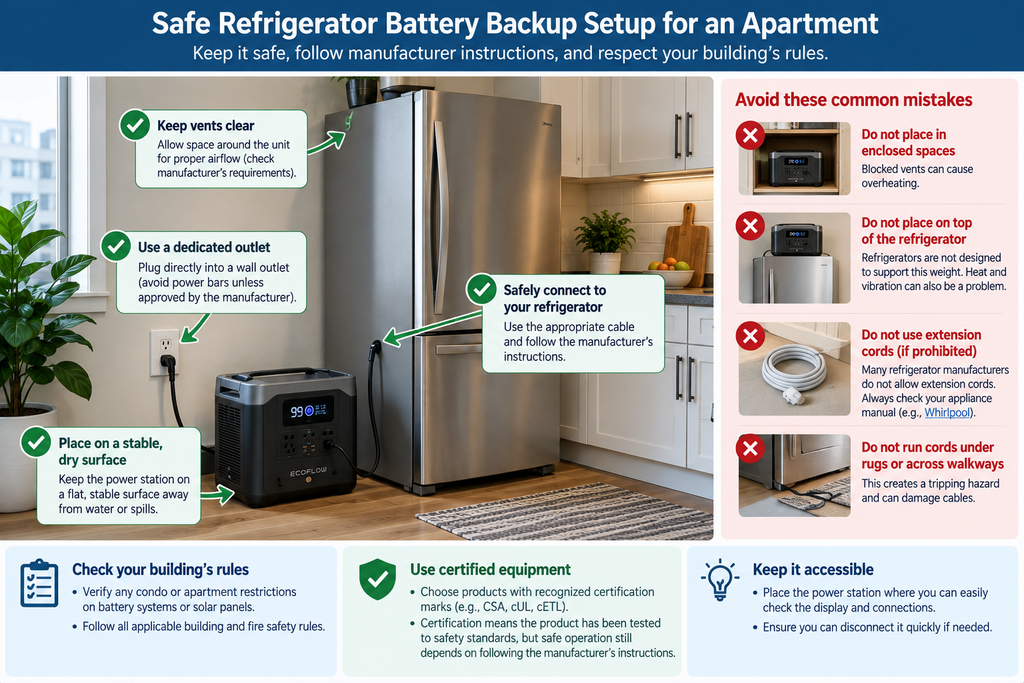
- Airflow and Fan Clearance: Inverters generate heat under load. Follow the manufacturer’s required clearance around cooling vents (typically several inches of open airspace). Never enclose an active power station in a tight, unventilated cabinet or pantry.
- Placement and Mounting: Do not place a power station on top of a refrigerator or mount it on a wall unless the manufacturer explicitly permits that configuration. Check weight limits, surface stability, fastening requirements, access, heat, and airflow.
- Electrical Safety Certification: Choose equipment carrying a legitimate electrical safety certification mark recognized in your country (such as UL in the U.S., or CSA, cUL, and cETL marks in Canada). Certification indicates assessment against applicable safety standards, but safe operation still requires following the manufacturer’s installation, charging, and ventilation instructions.
- Extension Cord Rules: Connect the refrigerator directly when possible. Check both the refrigerator and power-station instructions before considering any extension cord. If either manufacturer prohibits extensions (such as Whirlpool’s guidance against appliance extension cords), do not use one. If extensions are expressly permitted, follow the specified cord type, length, rating (e.g., 12 AWG or 14 AWG grounded 3-prong cord), and grounding requirements.
- Building Rules and Restrictions: Check applicable apartment, lease, or condominium rules before wall-mounting batteries, storing equipment in shared spaces, or installing balcony solar panels. Portable batteries avoid permanent wiring or panel changes, making them well-suited for renters. Do not attempt to backfeed household receptacles or modify apartment electrical panels.
- Zero Gas Generators Indoors: Combustion generators produce deadly carbon monoxide gas and must never be operated indoors, in garages, or on enclosed balconies. Fuel-burning generators must operate outdoors and far away from buildings, doors, and windows, as emphasized by Health Canada and the U.S. Consumer Product Safety Commission (CPSC).
- Recharging During Outages: Utility-based AC recharging requires grid power to return (such as during intermittent rolling blackouts). During sustained grid failures, recharging depends on alternative arrangements. While balcony solar panels can provide emergency top-ups in some cases, urban shading and limited balcony space make solar an uncertain primary recharge method for renters.
- Medication Storage Precautions: Temperature-sensitive medications (such as insulin) require reliable temperature control. However, storage requirements vary depending on the specific product, formulation, and whether it has been opened. Consult a pharmacist or healthcare provider when planning emergency backup storage for critical medications.
Final Recommendation: Which Setup Makes Sense?
Selecting the best portable power station for refrigerator needs comes down to balancing capacity, idle efficiency, physical footprint, and cost. While a refrigerator battery backup is not a mandatory purchase for every small household, it provides practical resilience if your building experiences frequent or prolonged blackouts. To make a practical choice, follow this 3-step action plan:
- Assess Your Need: Check your local outage history and food value. If outages rarely exceed four hours, rely on closed-door thermal management or simple ice cooling.
- Calculate Your Target Capacity Tier:
- 1 kWh Battery: A 1 kWh battery may provide approximately 6–12 hours of refrigerator backup depending on your refrigerator’s draw and inverter idle consumption.
- 2 kWh Battery: A 2 kWh battery may provide approximately 13–25 hours of backup under the examples above.
- Calculate the required capacity for your target outage duration rather than assuming that a fixed battery size guarantees overnight or 24-hour protection.
- Verify Settings and Test: Ensure automatic AC power-saving modes are configured for continuous output, verify safety certifications, plug the equipment in, and test your refrigerator through several compressor cycles before an actual blackout occurs.
For further information on home power resilience, consult our related guides on apartment food safety during power outages and how to choose a portable power station for small homes.
[…] If your building experiences frequent or prolonged blackouts, passive cooling alone may not be enough to protect your groceries. Sizing an indoor-safe battery to keep your compressor running requires matching your fridge’s startup surge and continuous wattage against the battery’s usable capacity. ***To calculate your fridge’s real-world power draw and determine if a backup battery makes finan…*** […]