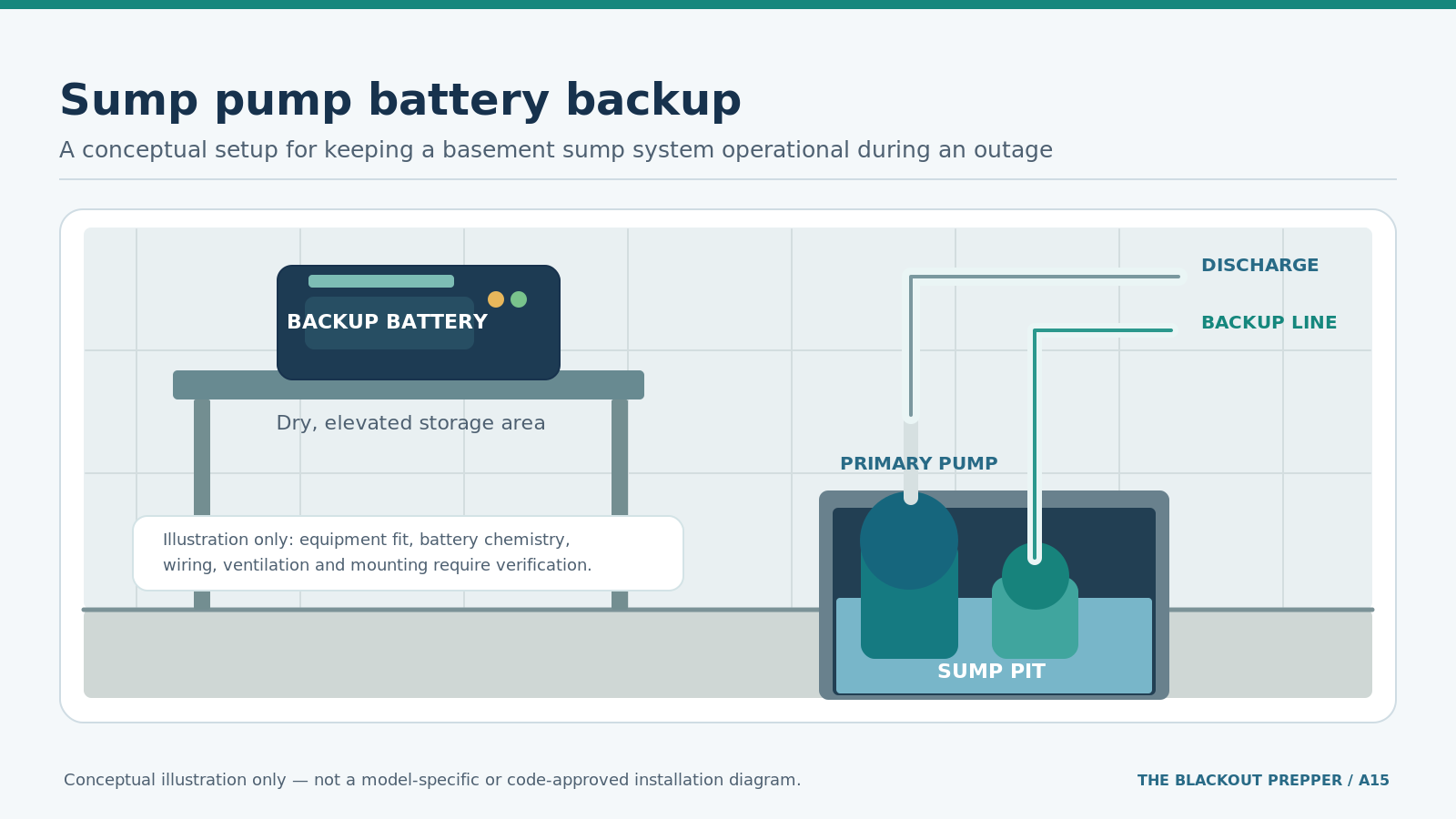
A power outage during heavy rain can stop an ordinary electric sump pump just when water is entering the pit. But keeping electricity available and having a second pump ready are not the same thing. One protects against loss of power; the other can also help when the original pump or its switch fails.
For many households that need protection against both problems, a dedicated battery-powered secondary sump pump is a useful starting point. Other options include a battery-and-inverter system for the existing pump, a preassembled primary-and-backup combination, or a water-powered backup where the household’s water supply and local rules make that feasible. None is a guarantee against basement flooding. Government of Canada: Sump pumps
This guide helps you shortlist the right type of protection, compare claims on product listings, and prepare useful questions for an installer. It is not a wiring or plumbing installation guide.
Flood and electrical safety: Do not enter a flooded basement or handle pumps, batteries, plugs or electrical equipment where water may be energized. If floodwater reaches outlets, a furnace or an electrical panel, stay out and contact your electric utility or a qualified emergency professional. See the Electrical Safety Authority’s outage guidance.
1. Decide what you need the backup to survive
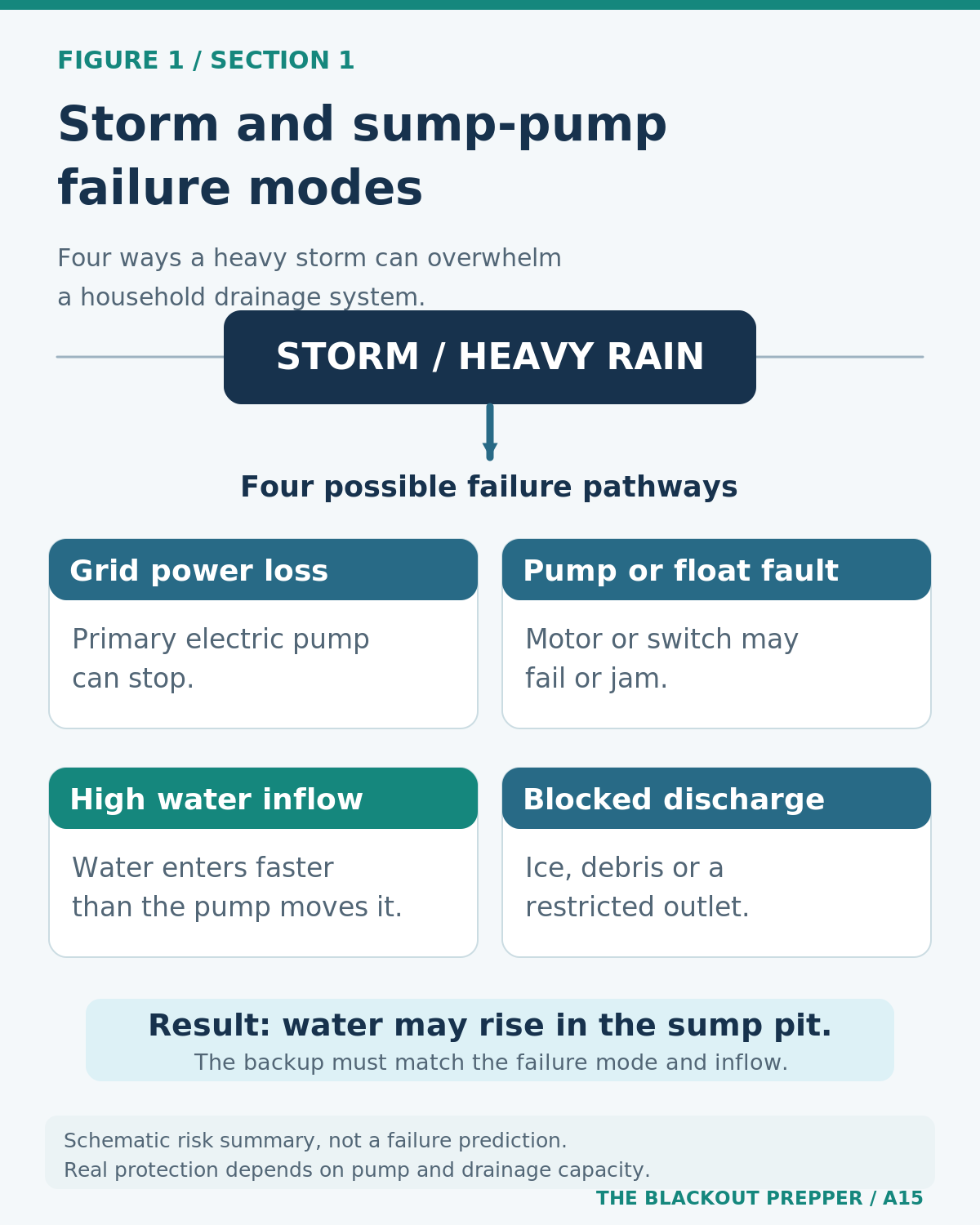
Before comparing batteries, answer one question: What if the primary pump stops working even though electricity is available?
- Power failure only: A correctly matched inverter or portable power station might keep the existing AC pump running. The original motor, switch and discharge system must still work.
- Power failure or primary-pump failure: A separate backup pump with its own activation mechanism adds another pumping path. It still depends on suitable capacity, available energy or water pressure, and a functioning discharge route.
- Water entering faster than the system can remove it: Neither a battery nor a second pump automatically solves an undersized or obstructed drainage system. This needs an assessment of the home’s actual water inflow and drainage arrangement.
The Government of Canada recommends an alternate power source and a backup sump pump because outage protection and pump redundancy solve different problems.
2. Compare the four main approaches
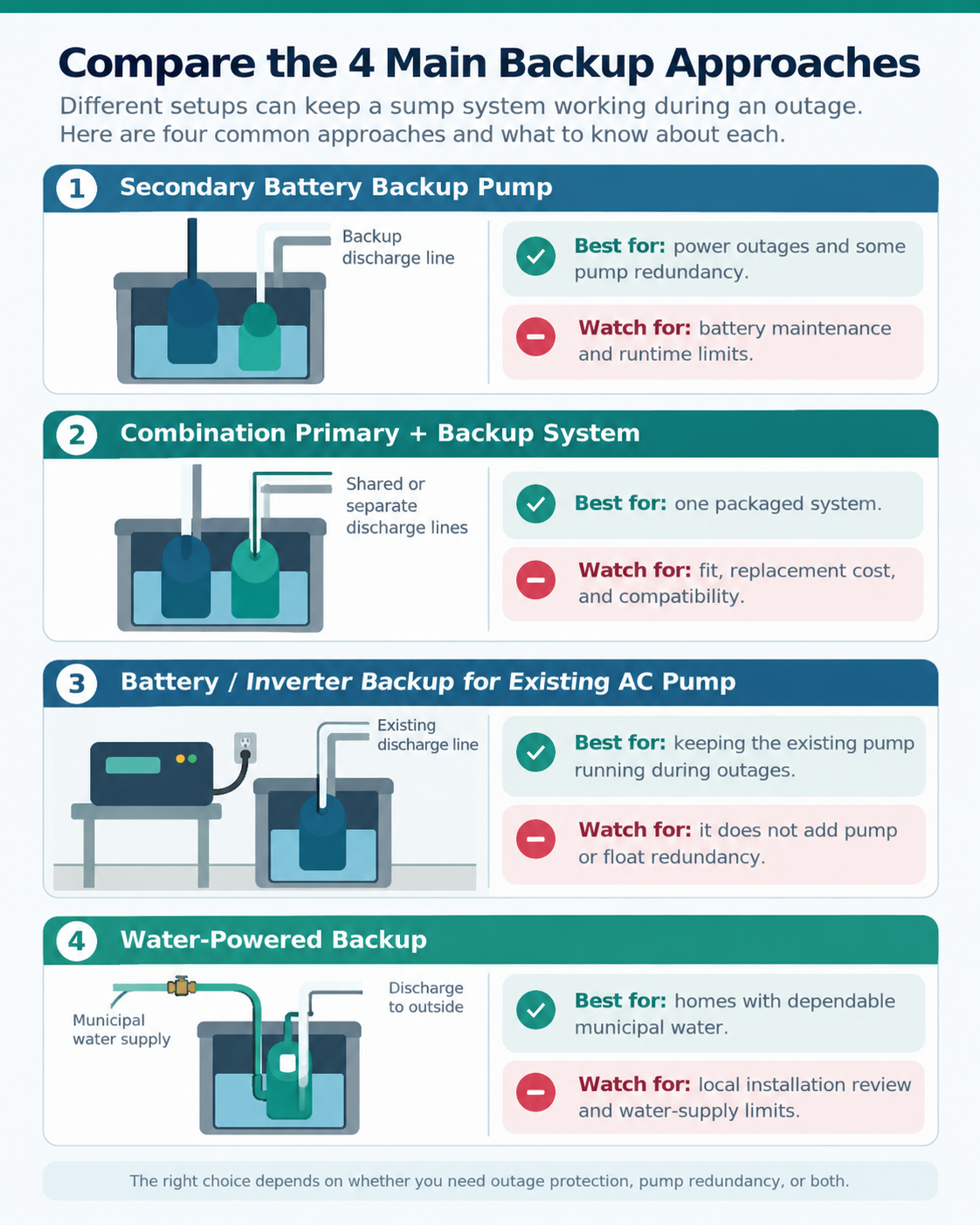
| Backup approach | What it helps protect against | Key limitation | Best starting point when… |
|---|---|---|---|
| Secondary battery-powered pump | Power outage and failure of the original pump or switch | Battery energy is finite; fit and installed pumping capacity must be checked | You want a separate pump without replacing a sound primary pump |
| Primary-and-backup combination system | Power outage and primary-pump failure | Usually involves replacing the primary pump as a package | Your existing pump is aging or due for replacement |
| Battery/inverter or portable power station feeding the existing AC pump | Power outage, if the pump and backup power system are compatible | The original pump and switch remain single points of failure | You specifically need power continuity for a working pump |
| Water-powered secondary pump | Power outage and primary-pump failure, while suitable municipal water service continues | Depends on water supply, approved plumbing arrangement and discharge capacity; consumes municipal water | You have municipal water and want to investigate a nonbattery alternative |
These are system categories, not interchangeable products. The table is a screening tool, not a statement that a particular device is suitable for your home.
A separate battery-powered pump: the usual place to begin
A dedicated secondary pump generally has its own activation mechanism, battery and charging/control system. It is intended to take over when water rises beyond the normal operating level. That makes it meaningfully different from plugging the original pump into a battery.
An example is the Liberty Pumps 442-Series. Its product documentation describes a DC backup pump and charger/controller; battery selection and actual pumping performance are model dependent. We have not tested this model, and its inclusion is not a best-product ranking.
Before choosing a unit, confirm that the pump fits your pit, can discharge water through an appropriate route, and has adequate flow for your home’s conditions. An installer can compare those needs with the manufacturer’s documentation.
Combination system: worth considering when replacing an old pump
A combo system packages an AC primary pump with a battery-powered secondary pump. For example, the Liberty PC 442-Series is sold as a primary-plus-backup assembly. This can be more convenient to evaluate when the original pump already needs replacement, although the total cost and fit still matter.
Battery and inverter: power backup, not pump backup
A portable power station or purpose-designed inverter system can potentially power an existing pump during a blackout. But motor-driven pumps create different demands from phones or laptops: the backup source must tolerate startup demand, support the intended unattended operation, and maintain output when the pump is idle between cycles.
Ask the equipment manufacturers or a qualified installer to verify that the particular pump and power source work together. A product described as a UPS or EPS is not automatically suitable. This approach also cannot rescue a jammed motor or stuck float switch.
Water-powered backup: a different dependency
Some secondary pumps use municipal water pressure rather than a battery. This can avoid battery depletion, but operation depends on sufficient continuing water service. It also consumes municipal water and requires a suitable, locally compliant water-supply and discharge arrangement. Those are questions for a qualified plumber, not do-it-yourself assumptions.
For example, the Liberty SJ10 SumpJet is described by its manufacturer as a municipal-water-powered backup; pumping performance depends on water pressure and the system’s pumping conditions. Homes that rely on an ordinary electric well pump should not assume they will retain the water supply needed during an outage.
3. Six checks before you spend money

1. How often does your pit fill during severe rain?
Occasional cycling and near-continuous pumping create very different demands. Make a note of how often the primary pump runs during a substantial storm from a safe location. If the pit has overflowed or the pump struggles to keep up, prioritise an assessment of water inflow and pump capacity rather than assuming that a bigger battery is the solution.
2. Is there space for a second pump?
The sump basin, primary pump, float mechanism, pipework and cover all compete for space. A model that looks compact online may not fit or operate without interference. Record the sump-pit dimensions and the existing pump’s make and model for an installer to check; avoid rearranging electrical or plumbing parts yourself.
3. How much water can the backup actually move?
A prominent gallons-per-hour (GPH) rating is not the whole story. Pump output changes with the elevation water must reach and resistance in the installed piping. Compare manufacturer performance information at relevant operating conditions, not merely a zero-lift headline number. If you do not know those conditions, ask an installer to establish them.
4. What does the runtime claim assume?
Battery-backup advertising may quote hours or pumping cycles. Those figures depend on the battery, pump, water inflow and how frequently the pump runs. Compare estimates only when you understand the test assumptions, and ask how heavy-rain operation changes the estimate. See the next section for a practical way to read runtime claims.
5. Will the system tell you when something is wrong?
A useful backup should make failures or maintenance needs apparent. Compare audible alarms, battery-status indicators, test functions and available remote notifications. Smartphone alerts may depend on home internet or cellular service that can also be affected by an outage; they should not be your only warning method.
6. What are the full costs and requirements?
Look beyond the pump price. Depending on the chosen approach, you may need a compatible battery, charger/controller, professional labour, adjustments to the discharge arrangement, ongoing battery testing and future replacement. For water-powered options, ask about metered water consumption and local restrictions before proceeding.
4. How long does a sump pump battery backup last?
There is no reliable single runtime for all sump pump battery backups. A battery’s advertised amp-hour or watt-hour capacity is useful information, but it does not tell you how long the complete system will protect a basement.
Think about two storms. In one, a backup pump starts briefly every so often. In another, water keeps arriving and the backup pump runs for much of the hour. The second storm uses stored energy much faster, even if the same battery and pump are installed.
When comparing runtime claims, look for these details:
- Battery model and condition: What type and capacity were used for the published estimate, and what maintenance or replacement does the manufacturer require?
- Pump duty cycle: Is the stated duration based on continuous pumping or intermittent cycling?
- Installed pumping demand: What flow and lift conditions were assumed, and do they resemble your home?
- Reserve and alerts: How will you know if stored energy is running low during a long storm?
A larger battery does not automatically solve the problem. The pump’s controller and charger must explicitly support the selected battery chemistry and configuration. Use the product’s own compatibility documentation rather than substituting a different battery type based on a headline capacity alone.
For basic household battery concepts, our home backup-power sizing guide explains watts and watt-hours. Sump pumps add motor startup and changing pumping-duty demands, so treat generic appliance calculations only as background—not an installed sump-system runtime prediction.
5. Questions to take to a plumber or equipment supplier
You do not need to design the installation yourself to be an informed buyer. Bring the make and model of your primary pump, the sump-pit dimensions, the existing backup arrangement (if any), and a description of how often water enters during heavy rain.
Ask:
- Which failure modes does the proposed system cover? Does it continue operating if the primary pump motor or float switch fails, or only when the grid fails?
- Is the proposed pump suitable for this pit and drainage system? Is there enough room for the moving parts, and is its capacity adequate under the home’s actual conditions?
- What plumbing and electrical work is required? Who will check permitted discharge arrangements, appropriate water-supply protection (for water-powered models), circuits, battery location and ventilation under local rules?
- Which battery or power source is approved for this exact controller and pump? Is unattended startup after an outage supported and demonstrably reliable?
- What is a defensible heavy-rain runtime expectation? Which battery, pumping conditions and duty-cycle assumptions support the estimate?
- How will I test and maintain it? What are the manufacturer’s inspection intervals, warning indicators, battery-testing procedure and service requirements?
Request the manufacturer’s installation and maintenance manual for the exact model, and ask the installer to explain any limitations in writing. This guide does not tell you where to install valves, connect wires or size supply piping. Those decisions depend on the equipment, property and applicable requirements.
6. Keep the backup ready before the next outage
A system that has not been checked may fail when it is needed. The Government of Canada recommends routine primary-pump testing and periodic backup inspections. Follow the more specific maintenance schedule supplied with your actual equipment.
A homeowner’s practical checklist is to confirm that the system has no warning indicators, know where its manual is stored, arrange battery assessment and replacement when indicated, and make sure a qualified person has explained how to conduct a safe functional test. Do not run pumps dry unless the manufacturer explicitly permits that test method. Do not attempt checks in a wet or electrically hazardous area.
It is also worth preparing for what happens if the backup is overwhelmed. Identify a safe way to contact emergency help or a service provider, and keep your first-24-hours power-outage checklist available.
7. Frequently asked questions
Can a portable power station run a sump pump?
Possibly, but do not assume compatibility. The pump’s startup demand, the power station’s output and transfer behaviour, and whether it remains active while the pump is idle all matter. Ask the manufacturer or a qualified installer to verify the complete combination. It will still depend on the original pump functioning.
Is a second battery-powered pump better than a battery for my existing pump?
They serve different purposes. A separate pump can add protection against failure of the original pump or switch. An inverter supplying the original pump primarily addresses a power interruption. For a home where pump failure is a major concern, that distinction matters more than battery capacity alone.
Can a water-powered sump backup work with well water?
A water-powered backup should not be assumed dependable during an outage when the home gets pressure from an electric well pump with no independent backup. Check the specific model and water-supply requirements before considering this approach.
What battery should I buy for a sump pump backup?
Start with the exact backup pump and controller model. Select only a battery chemistry, capacity and arrangement supported by its manufacturer. Do not substitute a lithium battery into a lead-acid charging system without documented compatibility.
Can a backup sump pump guarantee a dry basement?
No. A backup may still be limited by unusually high water inflow, insufficient installed pumping capacity, a blocked discharge, depleted energy or loss of municipal water supply. It reduces risk; it does not eliminate it.
Bottom line: buy the protection you actually need
If your main concern is both power loss and a broken primary pump, start your comparison with a separate battery-powered backup pump or a primary-plus-backup combination system. If you need only power continuity for an otherwise reliable pump, evaluate a compatible inverter or power-station arrangement, while acknowledging the loss of mechanical redundancy. If you have dependable municipal water, a water-powered backup may be another candidate, subject to a plumber’s assessment.
The most useful next action is small: write down your pump’s model, sump-pit dimensions and storm-time behavior, then request a proposal that explains which failures are covered, under what conditions, and what ongoing maintenance is required. That is a stronger buying decision than choosing a backup based solely on a battery size or a promised number of hours.