When power cuts out unexpectedly in an apartment, scrambling through dark hallways or fumbling in drawers for a dying flashlight makes it harder to move safely and find essential supplies. While single-family homeowners might rely on gas generators or outdoor floodlights, apartment dwellers and renters face limited space and building restrictions. Open flames pose severe fire hazards in dense multi-family housing, fuel generators cannot be operated safely indoors or on balconies, and storage space is often limited.
Lighting a rented apartment safely during a blackout does not require expensive hardware or permanent electrical modifications. By understanding how lumens translate to small spaces, selecting equipment with long low-mode runtimes, and arranging lights strategically throughout your home, you can keep key living areas usable and comfortable during brief power outages or extended storm blackouts.
The 3-Layer Apartment Lighting System
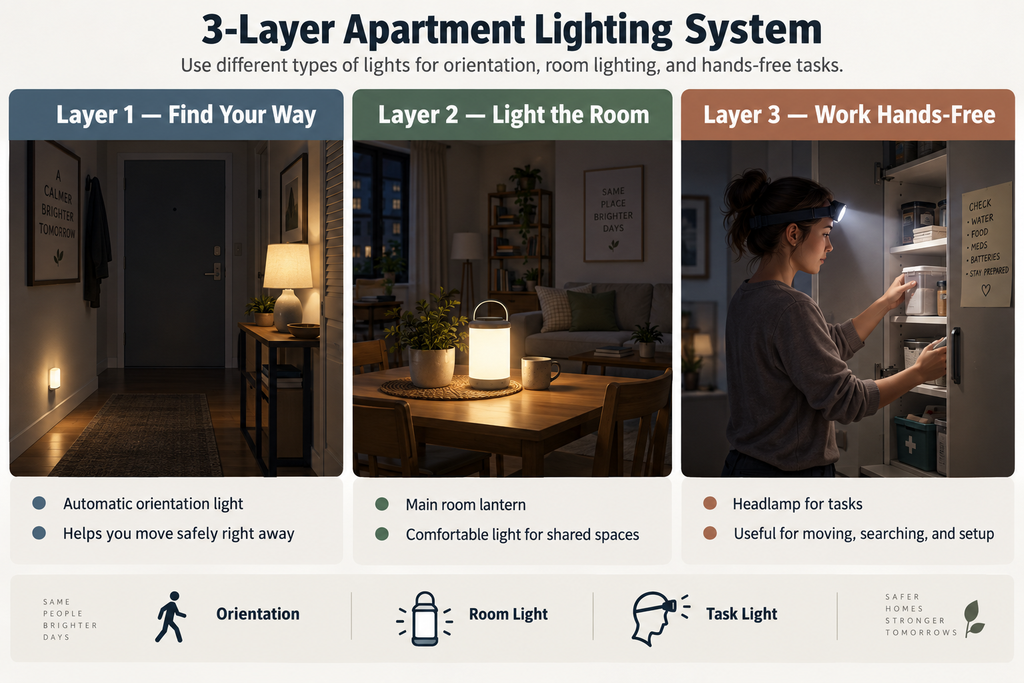
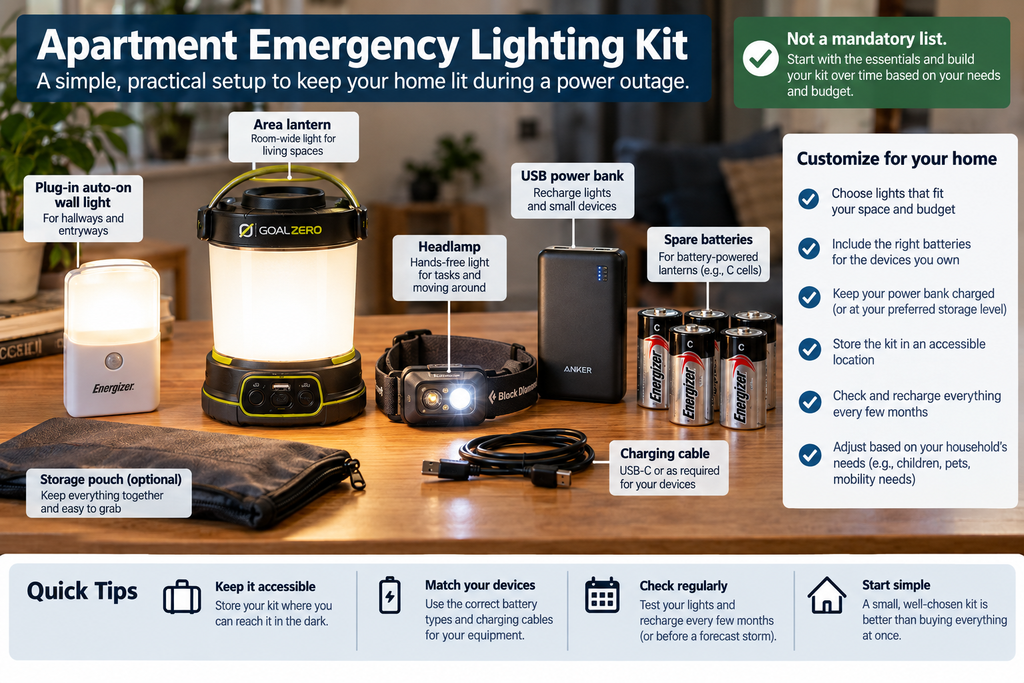
The most practical strategy for choosing power outage lights in a rental or small home is a 3-layer lighting system. Rather than relying on a single flashlight or lantern, using three complementary types of lights helps provide immediate orientation, comfortable room illumination, and safe hands-free movement:
- Layer 1: Automatic Orientation Lights (Plug-In Wall Lights & Backup Bulbs)
Purpose: Immediate visibility without searching for a flashlight.
Deployment: Plugged directly into dark hallways, entryways, and bathrooms, or installed in everyday table lamps.
Representative Examples: Energizer WeatheReady Auto-On wall lights; GE LED+, JackonLux, or Neporal rechargeable backup bulbs. - Layer 2: Area Illumination (Diffused Room Lanterns & Battery Lamps)
Purpose: Room-wide, 360-degree ambient light for cooking, reading, working, or family gathering.
Deployment: Placed on accessible countertops, dining tables, or sturdy eye-level shelves in main living spaces.
Representative Examples: Goal Zero Lighthouse 600, LUXPRO LP476v2, or BioLite Luci Charge 360 (formerly MPOWERD Luci Base Light). - Layer 3: Hands-Free Task Lighting (Compact Headlamps)
Purpose: Targeted directional light that moves with your gaze while keeping both hands free.
Deployment: Stashed in nightstand drawers or near circuit breakers for moving between rooms, locating supplies, or tending to family members.
Representative Examples: Black Diamond Spot 400-R or Spot 400 dual-fuel headlamp.
Illustrative Starter Kit Example
For a typical one-bedroom apartment, an illustrative starter setup might include:
- 1 Plug-in auto-on wall light in the main hallway.
- 1 Rechargeable backup bulb in a living room table lamp.
- 1 Area lantern (300–600 lumens) on a main living room shelf or counter.
- 1 Headlamp per adult stored in a bedside nightstand or kept within easy reach of the bed for those with mobility constraints.
- 1 USB power bank (10,000–20,000 mAh) kept fully charged.
Note: This kit is an illustrative example, not a mandatory five-item purchase list. A cost-conscious renter can start with a primary room lantern, a personal light accessible from bed, and power reserves, then add plug-in orientation lights over time for dark pathways.
Apartment Constraints: Fire Safety, Small Footprints, and Renter Rules
Preparing a rental property or condo requires respecting critical safety and spatial boundaries:
- Fire Safety & Open Flames: Open candles increase fire risks during power failures, particularly in dense multi-family buildings with children or pets. Battery-powered LED lights provide illumination without the open-flame hazard of candles. Keep all backup lights stable, clear of exit paths, and away from water unless specifically rated for wet conditions.
- Carbon Monoxide & Combustion Safety: Fuel-burning equipment—including portable gas generators, outdoor propane camp stoves, charcoal grills, and outdoor fuel heaters—produces deadly carbon monoxide (CO) gas. Public health and safety guidance (such as Health Canada CO Prevention Guidelines) recommends operating portable fuel generators at least 6 metres (20 feet) from buildings, with exhaust directed away from doors and windows—u distance generally impossible to achieve on an apartment balcony. Never operate outdoor-rated fuel-burning equipment inside an apartment, garage, or balcony. All apartment emergency lighting must be battery-operated, USB-rechargeable, or solar-assisted.
- Building Emergency Procedures & Evacuation: Personal emergency lighting supplements the interior of your apartment. Shared building corridors, stairwell lights, and building egress paths are governed by property management and local codes. Keep interior hallway paths clear and report failed common-area emergency lights to property management. If you cannot use stairs or may need assistance during an elevator outage, discuss an emergency plan with building management in advance.
- Managing Outage Expectations in Functional Phases: A few rechargeable devices cannot maintain full daytime brightness indefinitely. Adjust your lighting strategy as an outage continues:
- Immediate Orientation: Automatic Layer 1 lights turn on instantly to allow safe movement without searching in the dark.
- Usable Room Illumination: Layer 2 lanterns illuminate shared living spaces for ordinary evening activities.
- Energy Preservation: As an outage extends over multiple days, dim lanterns to low settings, use single-sided lighting modes, or consolidate household activities into a single primary room to conserve battery reserves.
How Bright Should Emergency Lights Be?
Selecting reliable power outage lights based only on maximum advertised brightness is a common mistake. A lantern with a high maximum lumen rating may be unnecessarily bright for a small apartment, especially when placed at eye level. Running lights at maximum brightness also consumes battery power much faster. Dimmable controls or adjustable settings let you balance comfort, visibility, and runtime.
How Lumens Translate to Small Spaces
Brightness needs vary based on room size, wall color, and task requirements. Lumens represent the total visible light emitted by a source:
| Household Area / Activity | Recommended Lumens | Functional Goal |
|---|---|---|
| Orientation & Nightlights | 8–15 lm | Low-level visibility to locate doorways or primary lights |
| Hallways, Bathrooms, & Entryways | 100–150 lm | Full path illumination for identifying obstacles |
| Living Rooms & Kitchens | 300–600 lm | Soft, diffused ambient light for meals, reading, and games |
| Focused Task Work | 50–200 lm (directed beam) | Targeted hands-free illumination via headlamp |
Note: Recommended lumen levels are approximate starting points. Actual light coverage depends on beam diffusion, fixture height, and room reflectivity.
The Low-Power Mode Advantage
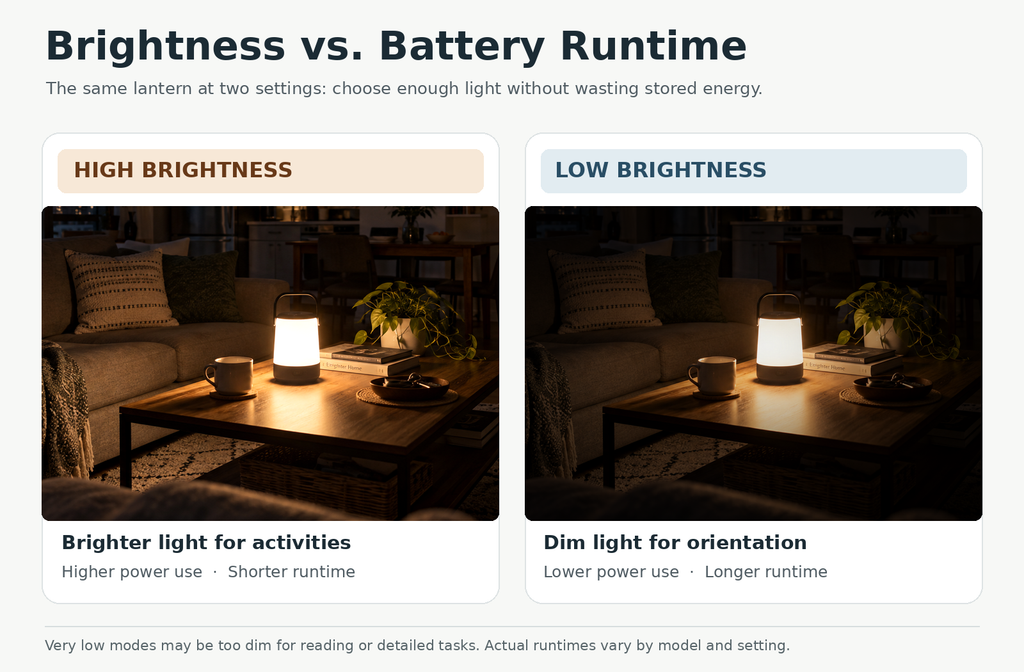
Brighter settings use more power and shorten battery runtime. Quality lanterns feature dimmable dials or low-power modes that drastically reduce battery draw while providing comfortable illumination for dark-adapted eyes. A lantern running on low mode for 180 hours can provide many more hours of low-level lighting during a multi-day storm than one that burns out after 2.5 hours at peak output.
However, very low settings (such as 5–10 lumens on lanterns or 6 lumens on headlamps) are intended primarily for nightlight orientation or conserving battery capacity—they may not provide enough illumination for reading, preparing food, or navigating cluttered areas. When evaluating equipment, review manufacturer-reported runtimes across settings rather than relying on peak numbers alone.
Layer 1: Automatic Wall Lights and Rechargeable Light Bulbs
The first few minutes of an unexpected outage can be disorienting, especially at night. Layer 1 lighting turns on automatically when grid power fails, eliminating the need to search through drawers in total darkness.
Plug-In Automatic Wall Lights
Automatic plug-in lights remain plugged into standard 120 V wall outlets in dark hallways, bedrooms, or kitchens. For dark interior corridors or stairwells without convenient wall outlets, battery-powered options like battery operated wall lights provide flexible, non-hardwired orientation lighting. During normal grid operation, internal batteries trickle-charge while the light remains off or functions as a subtle nightlight.
- Operation & Setup: When grid power drops, internal sensors detect voltage loss and trigger the LED light automatically. For example, the Energizer WeatheReady Auto-On Light (RCL1NM2WR) uses an integrated Nickel-Metal Hydride (NiMH) battery. For automatic outage activation, the switch must remain in the ON position while plugged into the wall. Before first use, charge the unit continuously for 12 hours. Note that official manufacturer documents vary on initial charging requirements: the Energizer RCL1NM2WR Operating Instructions specify an initial charge time of 12 hours, whereas the Energizer RCL1NM2WR Technical Datasheet lists 24 hours. Follow the operating sheet included with your specific unit before initial deployment.
- Orientation Output vs. Path Illumination: The Energizer RCL1NM2WR delivers 8 lumens in automatic orientation mode—enough to help you locate a doorway or grab a main lantern without lighting a full corridor.
- Versatility: The body features retractable electrical prongs that fold flush into the casing, allowing the unit to function as a handheld flashlight that provides up to 2 hours and 45 minutes of continuous illumination on high, with lower-output settings available to conserve battery life.
Rechargeable Light Bulbs: Model-Specific Behaviors & Emergency Output
Installing an emergency light bulb (often marketed as a battery backup light bulb or rechargeable light bulb) allows standard lamps and fixtures to double as blackout protection during a grid failure. However, emergency output and operating behavior vary by model and brand:
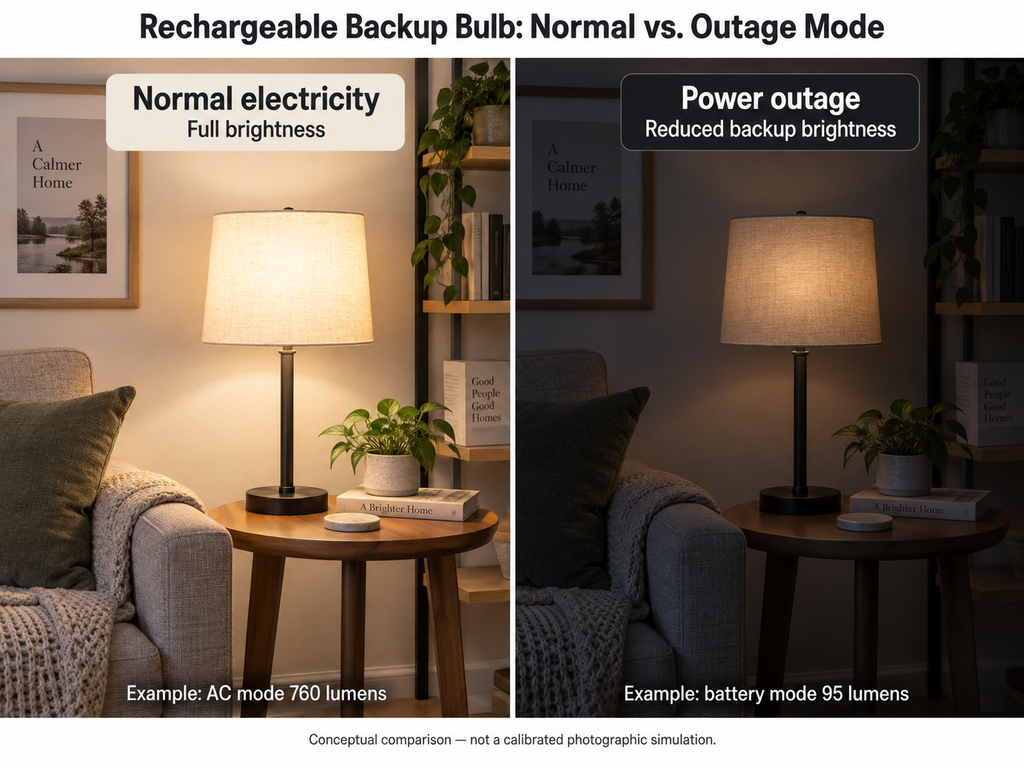
- Reduced Emergency Mode Lumens: Rechargeable backup bulbs provide full room lighting when AC power is available, but deliver reduced light output during an outage. According to the GE Lighting FAQ, standard GE LED+ Battery Backup bulbs deliver 760 lumens during normal AC operation, stepping down to 95 lumens in emergency battery mode (with up to 5 hours of backup runtime). By contrast, specific models such as the JackonLux CP-BL03-9WELN publish 800 lumens on AC power and 500 lumens in DC battery mode (with 2.5 to 3 hours of emergency runtime). Backup bulbs are excellent for immediate path-finding, but should be supplemented by a primary room lantern for extended activities.
- Switch & Circuit Behaviors: Rechargeable backup bulbs behave differently depending on the model and fixture design. For automatic activation when power fails, many models require the wall or lamp switch to be in the ON position. Certain models, including GE LED+ Battery Backup bulbs, can also be turned ON manually after an outage begins, provided the bulb remains installed in a closed circuit.
- Fixture Compatibility: Backup bulbs perform best in standard single-bulb table lamps. Multi-bulb ceiling fixtures, 3-way switches, or dimmer circuits can interfere with internal sensors, causing bulbs to flicker or re-trigger unexpectedly. Follow manufacturer instructions and test the bulb in your intended fixture before relying on it during an emergency.
Layer 2: Room-Filling Lanterns — 3 Primary Options
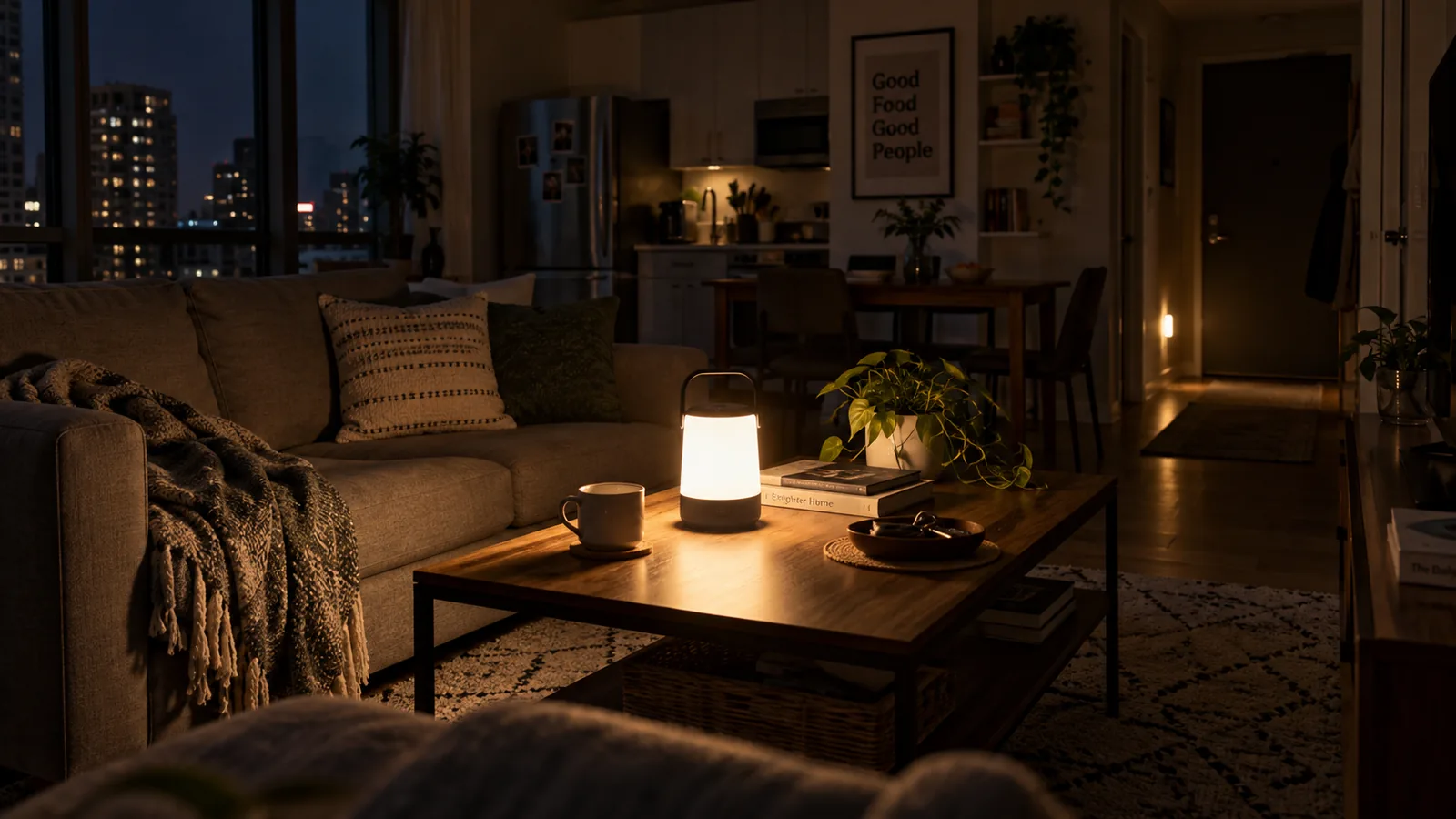
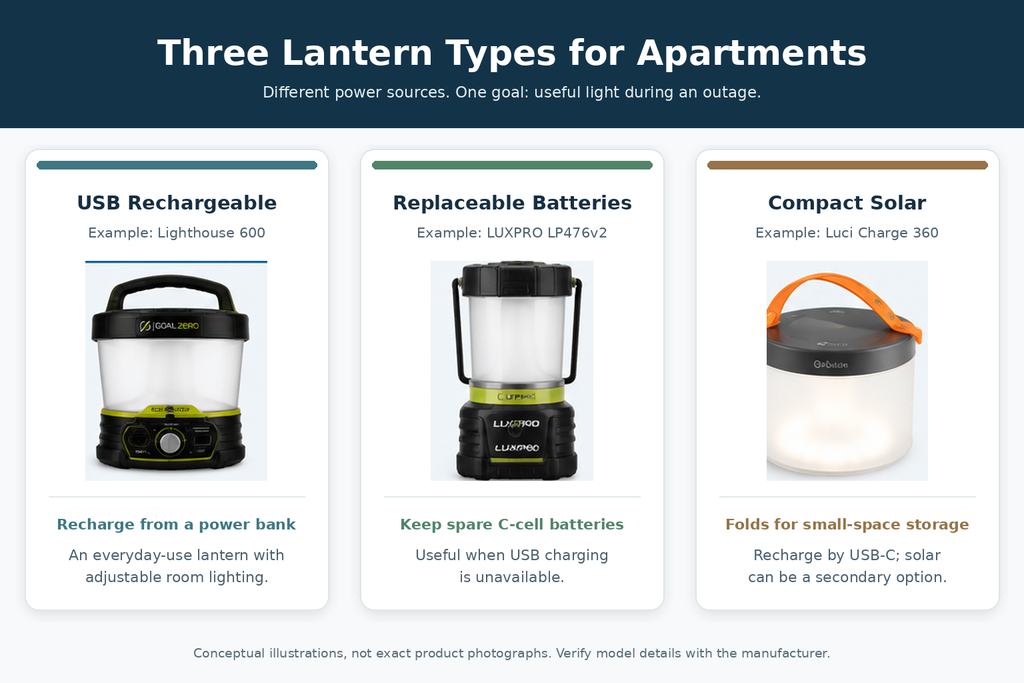
Once path orientation is secured, Layer 2 area lighting—such as compact rechargeable lanterns, battery operated lamps, or rechargeable table lamps—floods main living spaces with soft, 360-degree ambient light. Rather than accumulating specialized camping gear, apartment dwellers benefit most from selecting one of three primary lantern categories based on their charging setup and storage capacity:
Option A: The USB-Rechargeable Room Lantern (Goal Zero Lighthouse 600)
- Best Use Case: Primary living room or kitchen illumination with integrated device charging for short-to-medium outages.
- Manufacturer Specifications: According to Goal Zero Lighthouse 600 Specifications, the unit is powered by a 5,200 mAh (18.98 Wh) internal lithium battery and delivers up to 600 lumens maximum output. Goal Zero’s published runtimes are:
- High setting (both sides illuminated): 2.5 hours
- High setting (one side illuminated): 5 hours
- Low setting (both sides illuminated): 180 hours
- Low setting (one side illuminated): 320 hours
- Practical Advantages: Features a directional half-lantern mode to save power and reduce wall glare in compact rooms. A built-in USB-A port allows phone charging directly from the lantern battery (note that charging a smartphone consumes battery capacity, reducing available lighting runtime). Includes a folding handle and an integrated hand crank for emergency manual recharging (1 minute of cranking yields roughly 10 minutes of low light).
Option B: The Alkaline-Powered Shelf Lantern (LUXPRO LP476v2)
- Best Use Case: Multi-day storm readiness for households preferring long shelf-life replaceable batteries over USB recharging.
- Manufacturer Specifications: According to LUXPRO LP476v2 Product Specifications, the unit is powered by four C-cell alkaline batteries. Delivers variable white light up to 1,200 lumens alongside a dedicated red night-vision mode. Manufacturer-reported runtimes range from 7 to 85 hours depending on output settings.
- Practical Advantages: Quality alkaline C-cell batteries retain useful capacity for years in storage (with manufacturers advertising shelf lives of up to 10 years). The lantern includes a bottom-mounted D-ring allowing it to be hung overhead from sturdy ceiling hooks to reduce table and floor shadows.
Option C: The Compact Solar Folding Lantern (BioLite Luci Charge 360 (formerly MPOWERD Luci Base Light))
- Best Use Case: Small-apartment storage where closet space is minimal, with solar recharge capability.
- Manufacturer Specifications: Inflatable body collapses flat to 1.5 inches thick and weighs 10.1 ounces. Powered by a 4,000 mAh (14.8 Wh) internal battery. According to BioLite Luci Charge 360 Specifications (formerly marketed as the BioLite Luci Charge 360 (formerly MPOWERD Luci Base Light)), the unit delivers up to 360 lumens on maximum brightness, with a high-mode runtime of 5 hours and a low-mode runtime of up to 110 hours.
- Practical Advantages: Recharges via USB-C or built-in top solar panel. Stores flat in a drawer and provides soft, eye-friendly light through its frosted diffuser.
Layer 3: Task Lighting and Flashlights During a Power Outage
While reaching for a standard flashlight during a power outage is a common first reaction, relying solely on handheld lights or room lanterns while moving through an apartment can cast long shadows and occupy your hands. Using a compact headlamp ensures targeted, hands-free mobility.
Headlamps vs. Handheld Flashlights: Which Is More Useful?
Holding a traditional flashlight occupies one hand, making it difficult to carry water containers, assist children, prepare food, or open circuit breaker panels. A lightweight headlamp directs light wherever you look while keeping both hands completely free.
- Integrated Rechargeable Headlamp (Black Diamond Spot 400-R):
- Specifications: Weighs 86 grams (3.0 ounces) with an IP67 dust/waterproof rating. Recharges via micro-USB.
- Performance: Emits up to 400 lumens on high, with manufacturer documentation listing up to 225 hours of continuous light at a dim 6-lumen low setting.
- Features: Includes a red night-vision LED mode and a digital lock mode to prevent accidental button activation in storage.
- Dual-Fuel Alternative (Black Diamond Spot 400 Dual-Fuel):
- Readers who prefer replaceable battery options can choose the separate Spot 400 Dual-Fuel model, which accepts either 3 AAA alkaline batteries or BD 1500 rechargeable battery packs. Storing spare AAA batteries applies to dual-fuel models like the Spot 400; integrated models like the 400-R rely on external USB power banks for recharging.
How to Keep Your Lights Running
Keeping emergency lights operating requires matching your power reserves to the duration of the blackout.
Short Outages (Under 24 Hours)
For brief power failures, USB-rechargeable lanterns and headlamps are convenient. Before anticipated storms, top off your emergency lights and standard phone power banks.
When evaluating power banks, capacity in Watt-hours (Wh) provides a clearer picture than milliamp-hours (mAh) alone:
- A typical 20,000 mAh phone power bank operates at an internal cell voltage of 3.7 V, representing 74 Wh of nominal stored energy ($20 \text{ Ah} \times 3.7 \text{ V} = 74 \text{ Wh}$).
- Accounting for typical USB voltage conversion efficiency (~80%), usable output energy is approximately 59 Wh.
- Taking internal charging losses of the receiving device into account, this reserve for an illustrative calculation assuming a receiving device with a hypothetical 10 Wh battery (accounting for internal charging losses), yields a planning estimate of 4 to 5 full recharges. Actual recharge counts vary based on specific lantern or headlamp battery capacities.
Extended Outages (Over 24 Hours)
During multi-day grid failures, stored USB energy can deplete. Maintain a dual-power reserve:
- Alkaline Reserves: Stock fresh spare alkaline batteries matching your equipment (e.g., C-cells for the LUXPRO LP476v2, AAA/AA for dual-fuel headlamps or small lights). Store batteries in original packaging in a cool, dry place. Clearly label stored batteries and keep them stored alongside the lantern for prompt installation. Remove alkaline batteries from devices during long-term storage to prevent chemical leakage and corrosion. To maintain immediate readiness without delay, rely on Layer 1 plug-in lights or rechargeable lanterns for instant orientation, allowing you a few calm moments to insert fresh cells into stored alkaline lanterns.
- Windowsill Solar Realities: Solar-rechargeable lanterns (such as the MPOWERD Luci) provide helpful off-grid energy replenishment. However, solar charging in apartments depends heavily on window orientation, season, daylight duration, cloud cover, and window glazing. Treat windowsill solar as a supplementary safety net rather than a primary energy source during winter storms.
Where to Place Emergency Lights in Your Apartment
When positioning emergency lights for home use across a compact rental or apartment, tailor your layout to dark transit paths, room functions, and occupant needs:
| Apartment Zone | Recommended Lighting Category | Ideal Placement Strategy |
|---|---|---|
| Hallways & Entryways | Layer 1: Plug-in auto-on wall light | Lower wall outlets along main walking paths |
| Living Room & Kitchen | Layer 2: 300–600 lm room lantern | Accessible countertops, dining tables, or eye-level shelves |
| Bedrooms | Layer 3: Compact headlamp | Nightstand drawers or bedside tables within arm’s reach of the bed |
| Bathroom | Layer 1 auto light or compact lantern | A compact water-resistant battery light on a dry, accessible surface, or a compatible automatic light plugged into an outlet away from splashes |
Note: Avoid placing lanterns on high refrigerator tops or overhead shelves where they are difficult or dangerous to reach in total darkness. Choose stable, accessible countertops, tables, or eye-level shelves. Note that plug-in auto lights like the Energizer WeatherReady are not watertight; do not place them where they could be pulled into a bathtub or sink. Keep all recommendations strictly within private apartment spaces; do not place personal equipment in shared building hallways or stairwells.
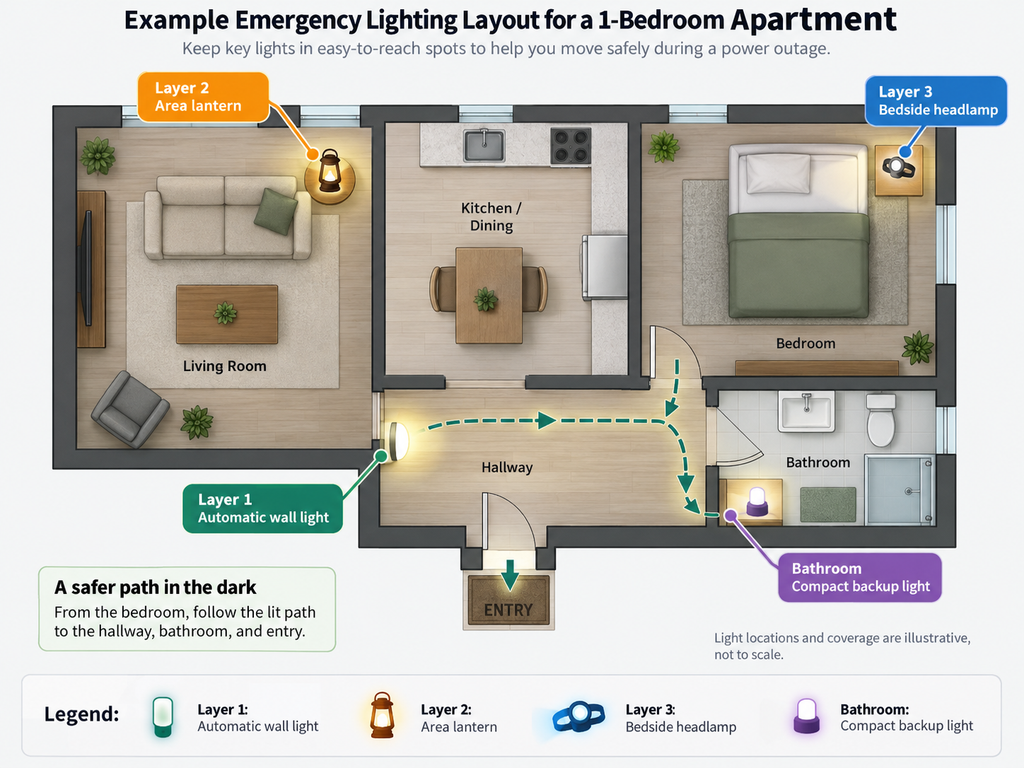
Illustrative Setups by Apartment Size
The following layouts are illustrative examples based on dark transit routes and occupant needs rather than rigid requirements:
- 1-Bedroom Apartment: 1 Plug-in auto-on light in the main hallway; 1 primary room lantern (300–600 lm) in the living room; 1 headlamp per adult in bedside drawers.
- 2-Bedroom Apartment: 2 Plug-in auto-on lights in hallways; 1 primary room lantern in the living room; 1 rechargeable backup bulb in a dining/kitchen lamp; 1 headlamp per adult; 1 compact light in the bathroom.
- 3-Bedroom Apartment / Condo: 3 Plug-in auto-on lights along interior corridors; 2 primary room lanterns (living room and kitchen); rechargeable backup bulbs in bedside lamps; 1 headlamp per occupant; 1 magnetic LED light near the interior electrical breaker panel.
Summary Comparison Table: 4 Categories of Emergency Lights
| Light Category | Primary Function | Power Source | Typical Runtime Range | Ideal Apartment Placement | Key Limitations |
|---|---|---|---|---|---|
| Plug-In Auto Wall Lights | Automatic path orientation | Wall outlet / Internal NiMH | 2 hrs 45 min (flashlight mode) | Dark hallways, entryways, bedroom paths | Shortest runtime; low lumen output (8 lm) for orientation only |
| Rechargeable Backup Bulbs | Daily lamp conversion | AC socket / Internal battery | 2.5–5 hrs (DC battery mode) | Living room table lamps, bedside fixtures | Delivers reduced lumens in DC mode (95–500 lm); fixture dependent |
| Area Room Lanterns | 360° ambient room light | Internal USB Li-ion or C/D cells | 2.5 hrs (high) to 180+ hrs (low) | Accessible counters, dining tables, living room shelves | Higher initial cost; larger physical storage footprint |
| Hands-Free Headlamps | Targeted task work & mobility | Micro-USB rechargeable or AAA | 4 hrs (high) to 225 hrs (low) | Nightstand drawers, near breaker panels | Directional beam; personal illumination only |
Test and Maintain Your Emergency Lights
Emergency lights are only useful if they function when grid power fails. Establish a simple testing and maintenance routine:
- Initial Setup & Charging: Upon purchasing rechargeable lights, charge them continuously according to manufacturer instructions (e.g., 12 hours for Energizer WeatheReady wall lights).
- Operational Blackout Testing: Separate your testing procedure into two distinct steps:
- Equipment Activation Test: Unplug auto-on wall lights from the outlet to verify power-failure activation. Test rechargeable light bulbs using their included power cap or by unplugging a single table lamp while switched ON. Do not turn off your main household electrical breaker to test lights.
- Navigation Walk-Through Test: Turn off ordinary room lights at night and walk through your apartment using only your emergency lighting setup. Verify that walking paths are lit, obstacles are visible, and headlamps are easily reachable from bed.
- Quarterly Maintenance Check: Every 3 months (and prior to forecast severe storms), check battery charge indicators on all USB devices and check rechargeable lights and power-bank charge levels. Follow each manufacturer’s storage recommendations—slch as those in the Anker Power Bank Safety Guide—and Recharge equipment before forecast outages when practical rather than keeping every lithium battery permanently at 100%.
- Battery Storage: Check spare alkaline battery expiration dates annually. Store batteries in original packaging in a cool, dry place, and remove batteries from unused devices during long-term storage to prevent chemical leakage and corrosion.
Actionable Next Steps: Setting Up Your Apartment’s Outage Lighting
To build a safe, space-conscious lighting plan for your rental home, follow this concrete setup checklist:
- Audit Your Layout: Count dark interior hallways, windowless bathrooms, and adult household members.
- Install Layer 1 Baseline: Place 1 or 2 plug-in auto-on wall lights along important dark routes, and consider installing a compatible rechargeable backup bulb in a frequently used table lamp.
- Select Layer 2 Room Lighting: Choose 1 central room lantern (such as a Goal Zero Lighthouse 600, LUXPRO LP476v2, or MPOWERD Luci) matched to your storage space and charging preferences.
- Stash Layer 3 Headlamps: Place 1 compact LED headlamp in each bedroom nightstand drawer with digital lock mode engaged.
- Assemble Power Reserves: Keep a charged USB power bank for rechargeable devices and a fresh supply of spare batteries matching any battery-powered lights you own.
Note: Performance, brightness, and runtime figures cited in this article are derived from manufacturer-reported specifications and product documentation under standard operating conditions. Real-world battery performance varies based on output settings, ambient temperature, device condition, and battery age. For official general emergency guidance, refer to the Government of Canada Power Outages: How to Prepare Guide.