When the power goes out in an apartment building, the immediate impact extends far beyond dark living rooms and unpowered televisions. For residents in apartment towers, condominiums, and rental complexes, a power outage can also disrupt the shared services your building provides. Shared infrastructure—including passenger elevators, water booster pumps, central heating boilers, and electronic security gates—relies on electrical controls that may respond differently when electricity is lost.
Understanding how your building’s infrastructure responds during an outage helps you anticipate which services will keep running, which may stop, and how to prepare safely without spending unnecessary money or violating lease and building rules.
Direct Answer: What Stops Working During an Apartment Power Outage?
During a blackout, shared building services behave according to their specific design, local building codes, and whether standby backup generators or battery systems are installed.
Emergency backup power systems in multi-family buildings are designed primarily to support essential safety systems rather than maintain routine residential convenience, though some properties also connect water pumps or other key utilities to generator power. Elevators usually do not continue normal passenger service during a blackout, although some buildings provide limited operation on a designated elevator. In many properties, elevators stop or follow a programmed sequence to return to a designated floor, open their doors, and remain out of service for general use.
Similarly, running water on upper floors and central hot water may be affected during a blackout. While lower floors may continue receiving cold water if municipal main pressure is adequate, upper floors often rely on electric booster pumps. Central hot water systems also depend on electric circulating pumps, electronic igniters, and digital controls.
The following table summarizes what residents should expect and verify regarding building utility systems during a power failure:
| Building Service | What Might Happen During an Outage | Key Verification Point |
|---|---|---|
| Emergency Lighting | Emergency lighting is intended to operate for its designated backup period via generator or batteries, subject to installed systems and their condition. | Ask management whether corridor lighting relies on backup generators or short-duration batteries. |
| Fire Alarms & Sprinklers | Fire alarm panels generally have required backup battery arrangements. Sprinkler reliability depends on municipal mains, dedicated tanks, and/or fire pumps depending on building design. | Confirm building fire safety procedures and emergency announcement protocols with management. |
| Elevators | Cabs may stop between floors, follow an automatic rescue sequence to discharge passengers at a landing, or provide limited service on standby power. | Check whether any elevator remains operational for general or emergency use during outages. |
| Cold Water Supply | Water may continue running normally, lose pressure, or stop entirely depending on building height, pressure zones, and plumbing design. | Ask whether your suite’s cold water supply relies on electric booster pumps. |
| Hot Water | Hot water may remain temporarily available in storage tanks, but ongoing heating and loop circulation depend on electrical controls and pumps. | Identify whether hot water uses central boilers or individual suite heaters. |
| Heating & Cooling | Central boilers, chillers, circulation pumps, and suite fan coils usually require electricity to move air or hydronic fluid. | Verify if any building heating or circulation equipment connects to backup generator power. |
| Security & Entry Doors | Access readers, electric locks, intercoms, and powered gates may continue on backup power, switch to battery backup, or stop functioning. Required exit routes permit emergency egress, but re-entry may be restricted. | Ask management about backup access procedures when card readers or intercoms lose power. |
Do Elevators Work in a Power Outage?
Elevators can require substantial electrical power, and a building’s standby system may be designed to operate only selected cars rather than every elevator at once. Standard building generators are rarely sized to run all cabs continuously for routine resident travel.
What Happens to Elevators When the Power Goes Out?
A power outage and a fire emergency are not the same elevator event. Firefighters’ Phase I Emergency Recall is a fire-service function initiated by specified fire-detection systems or authorized manual key switches.
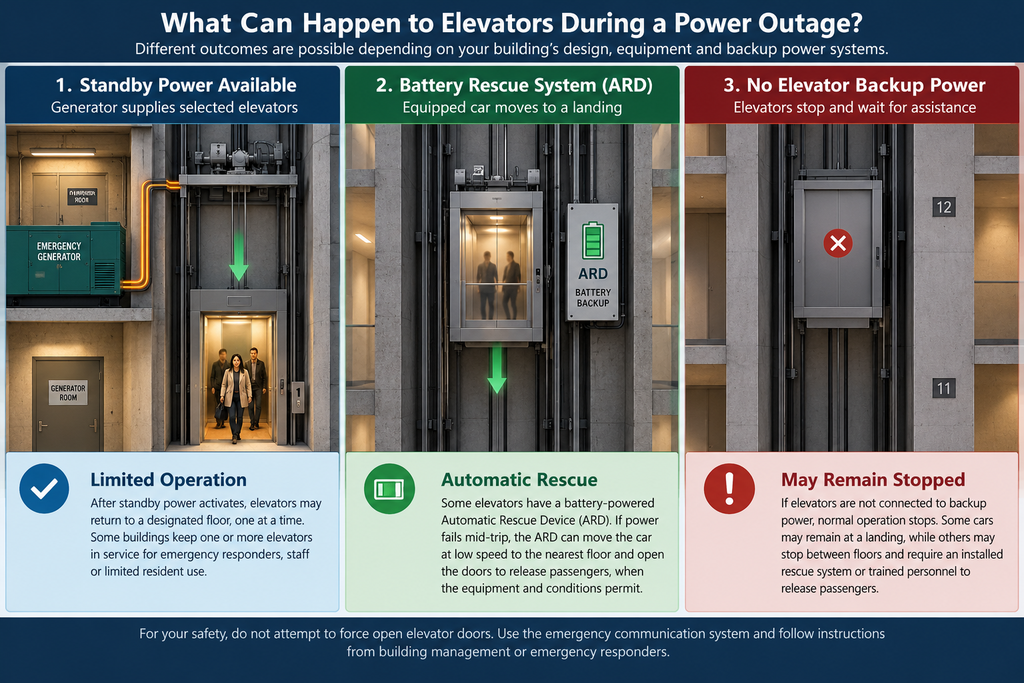
During an elevator power outage, an elevator controller responds according to its standby power programming:
- Programmed Landing Sequence: After standby generator power becomes available, the elevator system may carry out a programmed return sequence, energizing cabs one at a time to bring them to a main landing (usually the lobby), opening the doors to allow passengers to exit, and parking them.
- Limited Standby Operation: Depending on building design and local regulations, one or more designated elevators may remain operational on generator power for emergency responders, staff, or limited resident use.
- No Standby Elevator Power: If elevators are not connected to backup power, normal operation stops. Some cars may remain at a landing, while others may stop between floors and require an installed rescue system or trained personnel to release passengers.
Battery Automatic Rescue Devices (ARD)
Some elevators feature a battery-powered Automatic Rescue Device (ARD). An ARD is an auxiliary battery system independent of a building generator. If utility power cuts mid-trip, the ARD senses the loss, releases the elevator brake, and uses battery power to move the cab at low speed to a landing, opening the doors to release passengers when the equipment and operating conditions permit (see Otis Gen2 Premier Automatic Rescue).
Why Elevators Don’t Simply Fall When Power Fails
Traction elevators rely on fail-safe mechanical design. Electrical power is required to hold a traction elevator’s machinery brakes open. When electrical power is lost, spring-applied machinery brakes automatically engage to hold the drive sheave securely, while independent mechanical safety gear on the elevator frame guards against overspeed conditions.
Elevator Entrapment Safety and Protocols
If you are inside an elevator cab when grid power fails:
- Use Emergency Communication Equipment: Press the emergency alarm button or use the built-in emergency telephone. This may connect to building security, property management, or an off-site monitoring service. If occupant health or safety is immediately threatened, call 911 from a mobile phone.
- Remain Calm Inside the Cab: Elevator cabs feature permanent structural ventilation openings. Required emergency cab lighting and communication arrangements depend on installed equipment and battery condition. Occupants should stay inside, use communication equipment, and report breathing difficulties or urgent medical needs immediately (for additional safety guidance, see University of Toronto Elevator Entrapment Advice and Otis — Elevator Safety During Natural Disasters).
- Never Attempt Self-Rescue: Do not attempt to force open cab doors or climb through ceiling hatches. Uncontrolled hoistways pose severe fall hazards, and power could restore unexpectedly. Wait for trained elevator technicians or fire department rescue personnel.
Why Is There No Water in Apartment Building Outages?
A common surprise for residents during a blackout is finding water not working in apartment taps. When there is no running water in apartment units during an outage, the cause usually traces back to building height, pressure zones, and plumbing design (see City of Toronto Mid-to-High Rise Building Resilience Guidance).
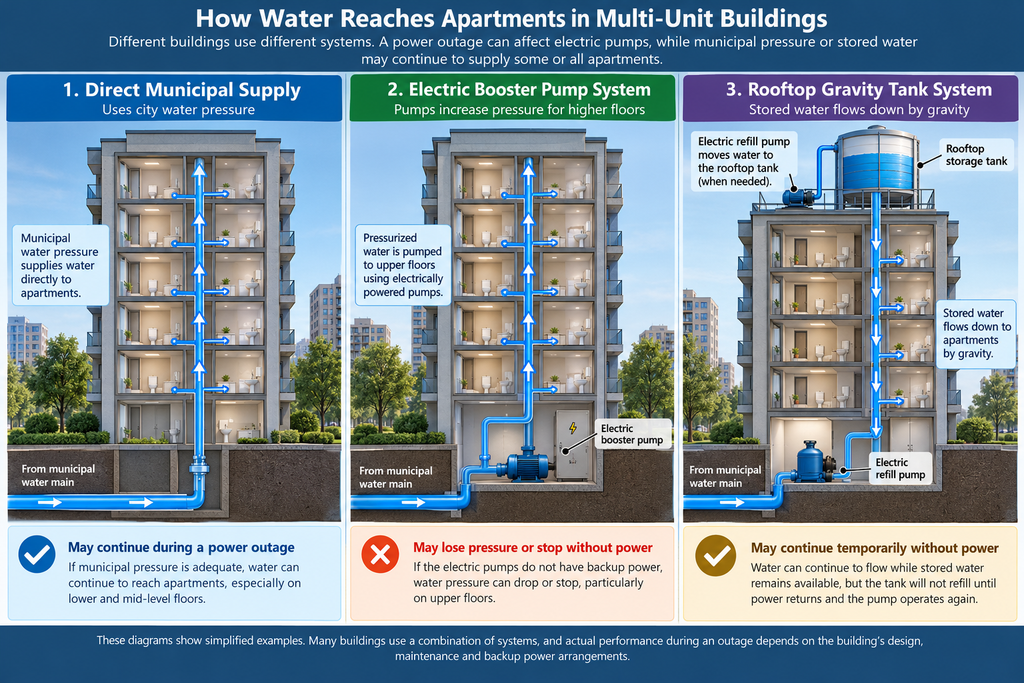
Three Building Water-Delivery Arrangements
- Direct Municipal Supply: In some buildings, municipal water pressure feeds apartments directly. Cold water may remain available during a building blackout provided the municipal water supply remains pressurized and the building does not depend on an unpowered pump for that part of its plumbing.
- Pump-Dependent Supply: Other buildings use electric booster pumps to supply one or more pressure zones. If those pumps lose power without backup, water pressure may weaken or stop, particularly in zones supplied exclusively through pumps. The outcome depends on the building’s piping, controls, and any stored pressure or water.
- Rooftop Storage Tanks: In some buildings, electric refill pumps push water UP from the municipal supply into an elevated rooftop tank. From the tank, gravity delivers water DOWNWARD to individual apartments. Residents may continue receiving water temporarily after the pumps stop, until stored water or usable pressure becomes insufficient.
Do not rely on a brief outage to guess how your plumbing works; ask building management which arrangement serves your apartment and whether the relevant pumps receive backup power.
Why Is There No Hot Water in an Apartment During a Power Outage?
When facing an apartment building no hot water scenario during a blackout, it helps to distinguish three separate factors: water pressure, hot-water storage availability, and the ability to heat additional water.
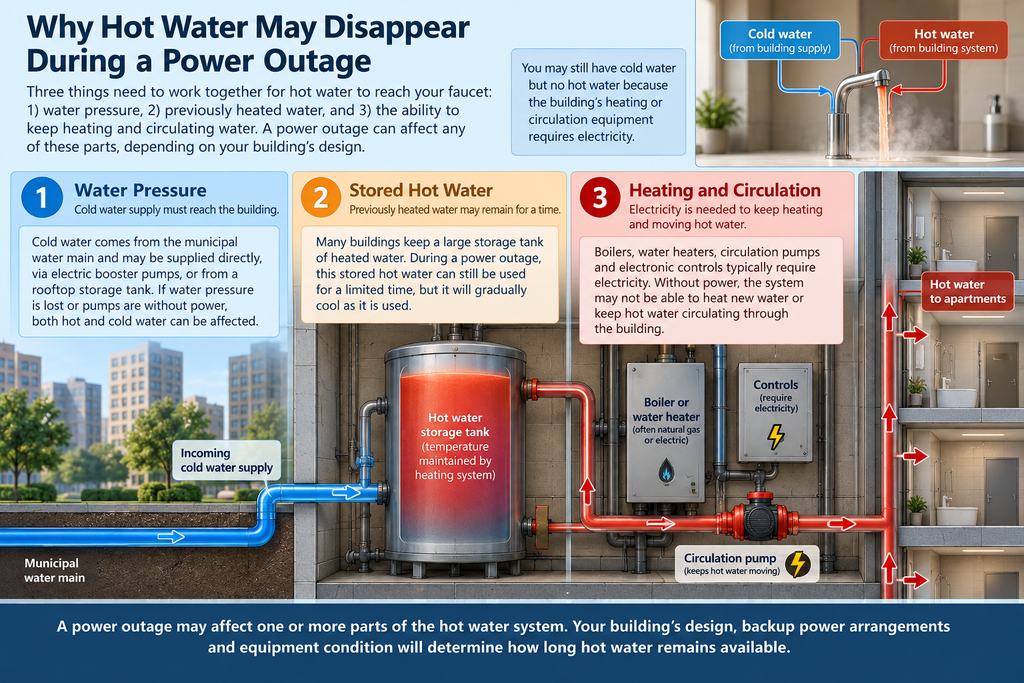
Central Boiler Causes: Hot Water Not Working in Apartment Outages
Even when an apartment building uses natural gas, oil, or municipal steam for heating, many central domestic hot water systems depend on electricity for controls, pumps, or associated equipment:
- Electronic Igniters and Logic Controls: Modern central boilers use electronic spark ignition and digital control circuits. When power is lost, burners shut down unless emergency power is provided.
- Recirculating Pumps: High-rise plumbing loops continuously circulate hot water through supply pipes so warm water is quickly available at faucets. Without electric recirculating pumps, water in supply lines sits static and gradually loses heat, increasing waiting time when taps are opened.
- Temperature Controls: Some hot-water systems use powered controls or actuated mixing valves. Their response to an outage depends on the installed equipment, potentially affecting delivered water temperature or availability.
In suites equipped with individual electric hot water tanks, heating elements turn off immediately, though an insulated tank retains warm water for several hours if used sparingly. Tankless electric water heaters stop heating instantly upon power loss.
What to Do If You Have No Hot Water in Apartment But Have Cold Water
A power outage can interrupt hot-water production or circulation without immediately exhausting water that was already heated. If you experience no hot water in apartment but have cold water continuing to flow at the tap, check building notices and ask management whether the central system has lost power. If only one fixture or suite is affected, or the problem persists after electricity returns, report it as a possible building maintenance problem or equipment fault rather than assuming the blackout is the sole cause.
What About Toilets, Security Doors, Heating, and Ventilation?
Beyond elevators and water taps, several other shared building services are impacted when utility power drops.
| Building Service | How Power Loss Affects Operation | Practical Resident Impact |
|---|---|---|
| Toilets & Wastewater | A tank-style toilet may flush once using water in its tank. Manual refilling may be possible using stored water if drainage remains functional. If a wastewater pump or sewage ejector loses power, fixtures depending on it may no longer drain safely. | Follow management instructions regarding toilet and drain use during an interruption. Stop using affected fixtures if a sewage backup occurs. |
| Electronic Entry & Doors | Access readers, electric locks, intercoms, and powered gates may continue on backup power, operate in a fallback mode, or stop functioning. | Required exit routes permit emergency egress under safety rules, but re-entry into the building or onto specific floors can be restricted when electronic card readers lose power. Ask management about backup access procedures. |
| Ventilation & Exhaust | Building fresh-air supply fans, bathroom exhaust fans, and kitchen vent risers may stop or operate at reduced capacity. | Humidity and cooking odors can accumulate; open windows slightly for air circulation if outdoor weather permits. |
| Building Intercoms | Lobby intercom panels and electronic unit buzzers rely on backup power arrangements, operating only as long as installed battery capacity lasts. | Arrange alternative communication (such as mobile phone calls or text messages) for visitors or delivery drop-offs. |
| Central Heating & Cooling | Central hydronic boilers, chillers, circulating pumps, and individual suite fan coils require electricity to move air or heating fluid. | Indoor cooling or heating loss rates depend heavily on outdoor weather, window glazing, insulation, building orientation, and suite location. Dress in layers to manage body temperature. |
What If You Cannot Use the Stairs?
For residents with mobility limitations, physical disabilities, or reliance on medical equipment, an elevator shutdown is a major safety concern rather than a simple inconvenience.
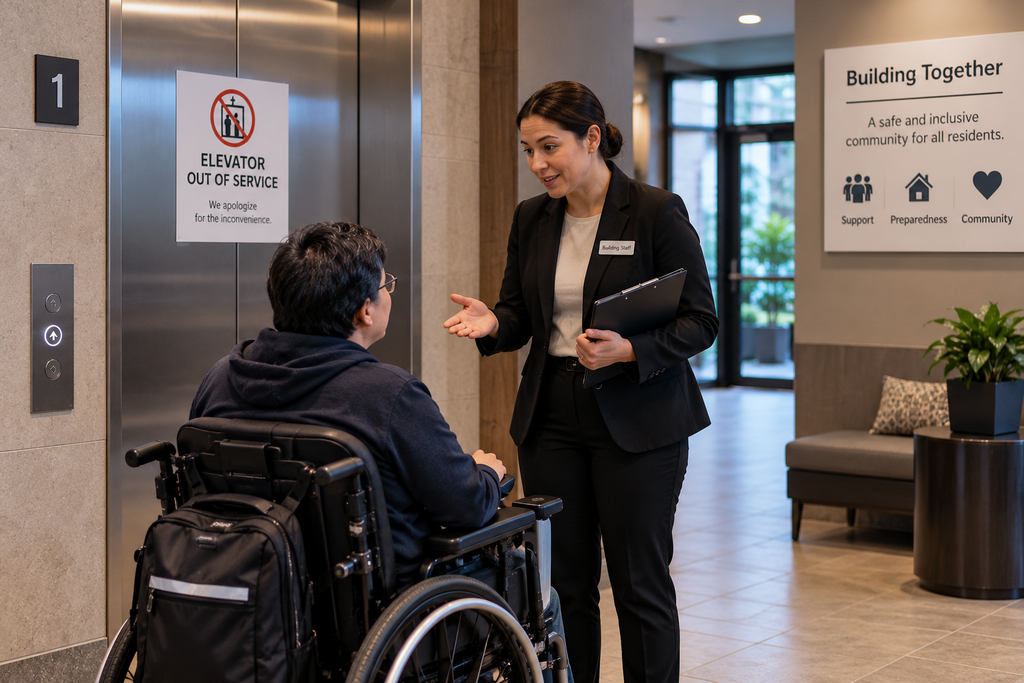
Emergency Assistance Planning
Public safety guidance from Emergency Management Ontario and municipal emergency agencies highlights essential planning steps (see Emergency Management Ontario — High-Rise Safety and City of Toronto — High-Rise Fire Safety):
- Confirm Management Lists: Ask property management whether your building maintains a voluntary Persons Requiring Assistance During Evacuation list. (Note for Toronto renters: Buildings covered under the RentSafeTO program are required by municipal standards to maintain a vital service disruption plan and a voluntary list of residents requiring assistance; see Toronto RentSafeTO Building Standards.)
- Document Specific Needs: Ensure building staff and security are aware of your specific mobility needs and apartment floor location. To protect privacy, share the practical evacuation assistance you require without disclosing unnecessary personal medical details.
- Build a Support Network: Establish a personal check-in agreement with neighbors, family members, or friends who can assist you during an extended outage.
An Assistance Registry Is Not a Guarantee
Where an assistance registry exists, ask how to join it and how the information is used; this should complement, not replace, an individual emergency plan. An assistance registry does not guarantee evacuation priority, immediate welfare checks, or emergency assistance within a specific timeframe. First responders prioritize life-threatening emergencies during widespread disasters.
If you rely on electricity-dependent medical equipment, work with your healthcare provider and medical equipment supplier to establish an equipment-specific emergency power plan or identify an accessible alternate location with a verified backup-power arrangement and an achievable transportation plan. Avoid improvised manual transfers down stairs by untrained individuals; follow building and emergency-service directions in fire or evacuation scenarios.
Questions to Ask Your Building Management
To prepare effectively, contact your property manager or HOA board with these specific questions:
- Will my apartment still have cold water if power fails? Ask whether the building uses booster pumps, pressure zones, rooftop tanks, or wastewater pumps, and whether those systems receive backup power.
- Which building systems connect to the emergency generator? Confirm whether standby power covers domestic water booster pumps, corridor outlets, or security gates in addition to stairwell emergency lighting.
- How do elevators operate during a power loss? Confirm if cabs feature Automatic Rescue Devices (ARD) and whether one elevator remains active on generator power for resident use.
- How long are emergency systems expected to operate on backup power? Ask what the building’s estimated backup fuel or battery duration is, and how residents will be notified if backup power is running low.
- Does the building maintain an emergency assistance registry? Verify how mobility-impaired residents are documented in the building’s fire safety and evacuation plans.
- How do electronic entry doors and gates operate during extended blackouts? Ask how residents gain physical access to the building if electronic card readers lose power.
- How will residents receive updates if building communications lose power? Ask whether management uses text messages, printed lobby notices, door-to-door staff checks, or another accessible method.
A Note on Evacuation Decisions
A power outage alone does not automatically mean you should evacuate. Whether it is safer to stay or leave depends on building conditions, emergency instructions, indoor temperature, access to essential services, and individual medical needs. If critical medical equipment is losing power or another immediate threat develops, seek emergency assistance. Follow your building’s emergency plan and instructions from emergency personnel rather than attempting an unsafe stair evacuation (for official outage guidance, see Ontario — Power Outages and Blackouts).
How to Prepare Your Apartment
Preparing your home for shared utility disruptions does not require expensive battery banks, permanent electrical modifications, or specialized emergency equipment. Focus on practical, space-conscious adjustments tailored for rental and condo living.
1. Water Storage (12-Liter Reserve Target)
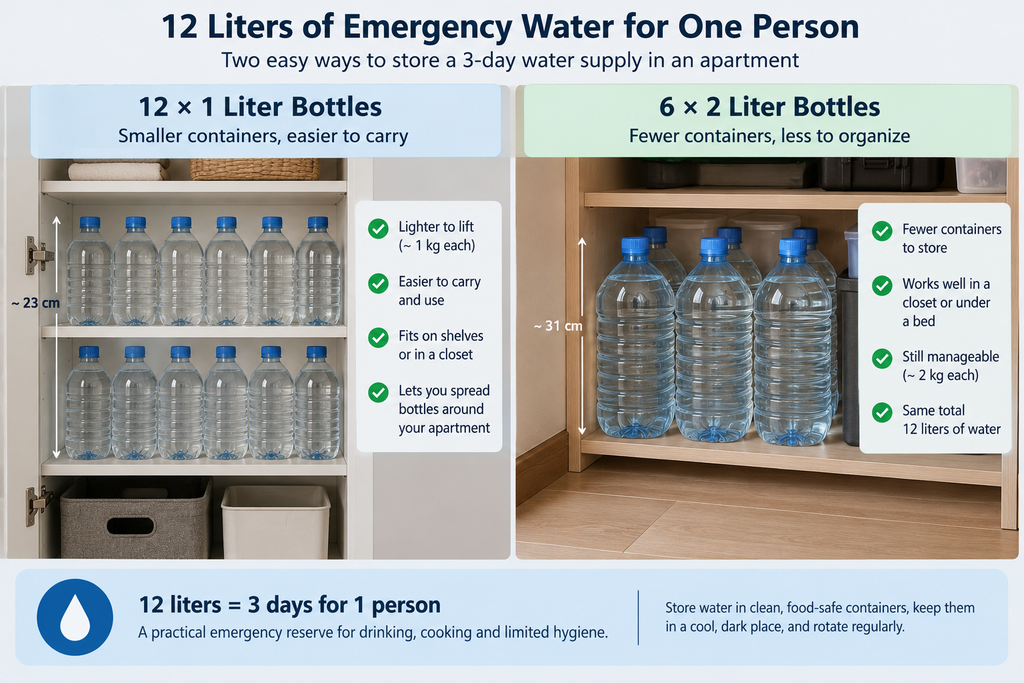
Emergency management guidelines recommend storing 4 liters (1 gallon) of water per person per day as a conservative planning target for drinking, cooking, and limited hygiene for a minimum of 72 hours (see Ontario Emergency Preparedness Guide and Government of Canada Emergency Preparedness Guide).
- Planning Target: A three-day emergency reserve for one person at the 4 L/day target requires 12 liters of water, plus additional allowances for pets or specific medical needs. Note that basic emergency supply reserves do not cover toilet flushing requirements.
- Container Weight and Accessibility: A filled 5-gallon (19-liter) water jug weighs approximately 19 kg (42 lbs), which can be difficult to lift and pour in a small space. Storing standard cases of 1-liter bottled water or smaller stackable containers under beds or in closet bottoms offers much better accessibility.
- Restored Tap Water: If water service is interrupted or loses pressure, follow local public health advisories or utility notices regarding potential boil-water advisories before drinking restored tap water.
- Detailed Checklist Links: For broader apartment supply checklists and storage rotation schedules, see our dedicated guide on Apartment Emergency Supply Checklists.
2. Space-Conscious Lighting and Communications
- LED Flashlights and Headlamps: Keep compact LED headlamps in an easily accessible nightstand drawer. Headlamps keep your hands free when navigating dark stairwells or hallways.
- USB Power Banks: Keep one or two charged USB power banks for phones and essential communications. A 10,000 mAh bank often provides roughly 1 to 2 full smartphone charges, depending on the phone model and charging efficiency; larger-capacity banks provide additional reserve.
- Wi-Fi Continuity: To keep home internet routers running during brief power cuts, see our dedicated guide on Sizing a Router UPS for Work-from-Home Continuity.
3. Thermal Management and Safety Boundaries
- Body Heat Retention: Focus on trapping personal body heat using thermal base layers, insulated blankets, and warm footwear. Low-energy tools like rechargeable USB hand warmers or low-wattage electric blankets connected to a compact power station provide efficient warmth. For detailed cold-weather management, see our guide on Winter Insulation and Draft Blocking for Apartments.
- Strict Indoor Safety Warnings: Never use fuel-powered combustion heaters (such as propane radiant heaters, kerosene stoves, or charcoal grills) inside an apartment or on enclosed balconies. These devices release deadly, odorless carbon monoxide gas and create severe fire hazards.
- Electric Space Heater Loads: Standard full-size electric space heaters can draw up to 1,500 watts on their high setting and will rapidly exhaust portable consumer batteries; focus on heating your body rather than the ambient room air.
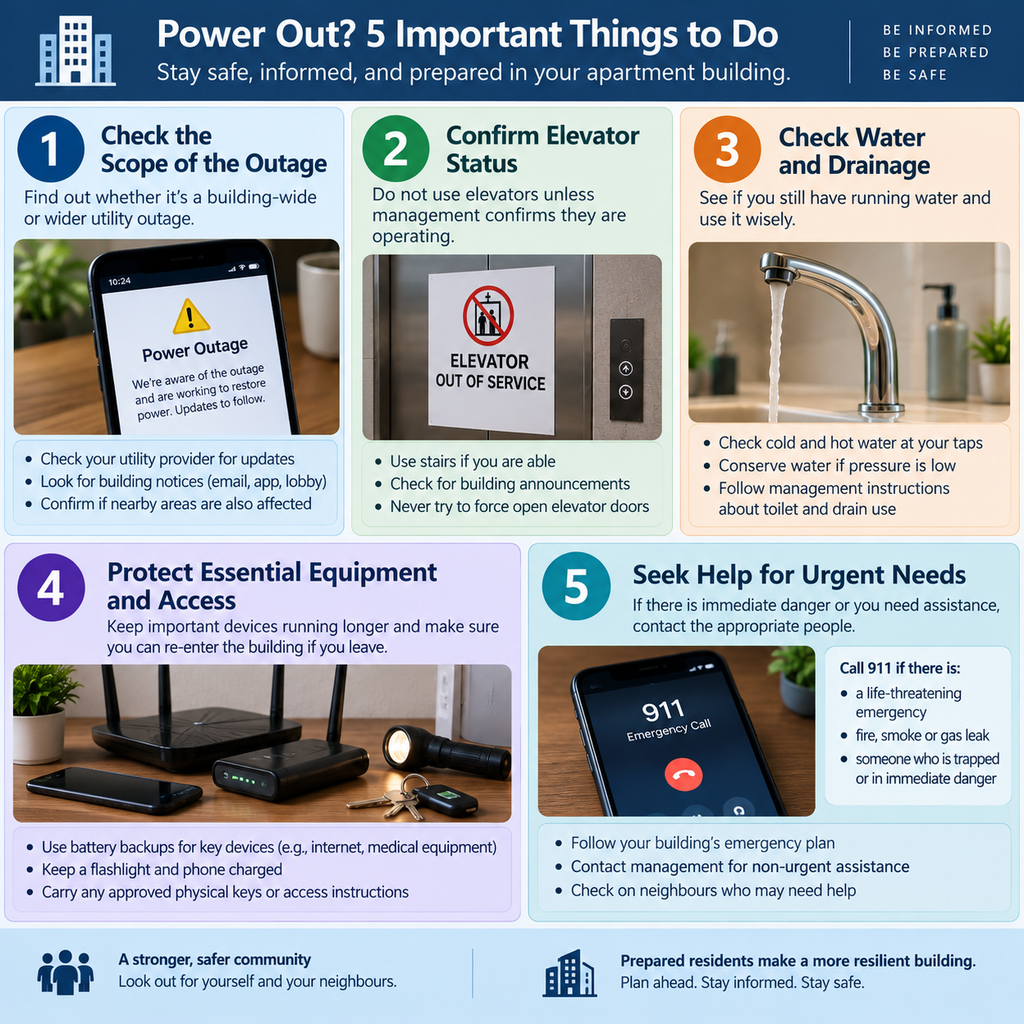
What to Do If the Power Is Already Out
If utility power has just failed in your building, taking organized immediate steps ensures safety and minimizes disruption:
- Check Outage Scope & Local Updates: Determine whether electrical failure affects your entire building or is isolated to your suite’s circuit breaker panel. Check mobile phone alerts or utility websites for local grid updates.
- Follow Elevator Safety: Do not use elevators unless management or emergency personnel have explicitly confirmed permitted service. If trapped inside an elevator, use the emergency communication button or call 911 for urgent medical threats, and wait for trained rescue personnel.
- Verify Tap Water & Conserve: Check whether tap water is running. Use stored supplies for drinking and cooking. If wastewater pumps lose power, follow management instructions and avoid using affected drains or flushing if backups occur.
- Protect Nonessential Electronics & Manage Access: Unplug nonessential electronics to prevent damage from power surges when utility electricity returns, while keeping medical devices connected to appropriate backup power. Before leaving your suite, ensure you have verified access methods or instructions for re-entering the building.
- Seek Emergency Help for Critical Needs: Contact management if essential building services stop, and call 911 immediately if you face a medical emergency or electricity-dependent medical equipment is failing.
Summary & Actionable Next Steps
Preparing for disruptions to shared building services comes down to understanding your building’s systems and taking three simple, low-cost steps today:
- Verify Your Water Supply: Ask building management whether your apartment depends on electric booster pumps, pressure tanks, or rooftop storage, and whether those systems receive backup power. Do not rely on a brief outage to determine how your water system works.
- Contact Management: Send a brief email to your property manager or HOA board asking the seven building-readiness questions outlined above.
- Stage Essentials: Store a 12 L emergency water reserve per person for drinking, cooking, and limited hygiene in easily managed containers, and keep a 10,000 mAh USB phone power bank fully charged.